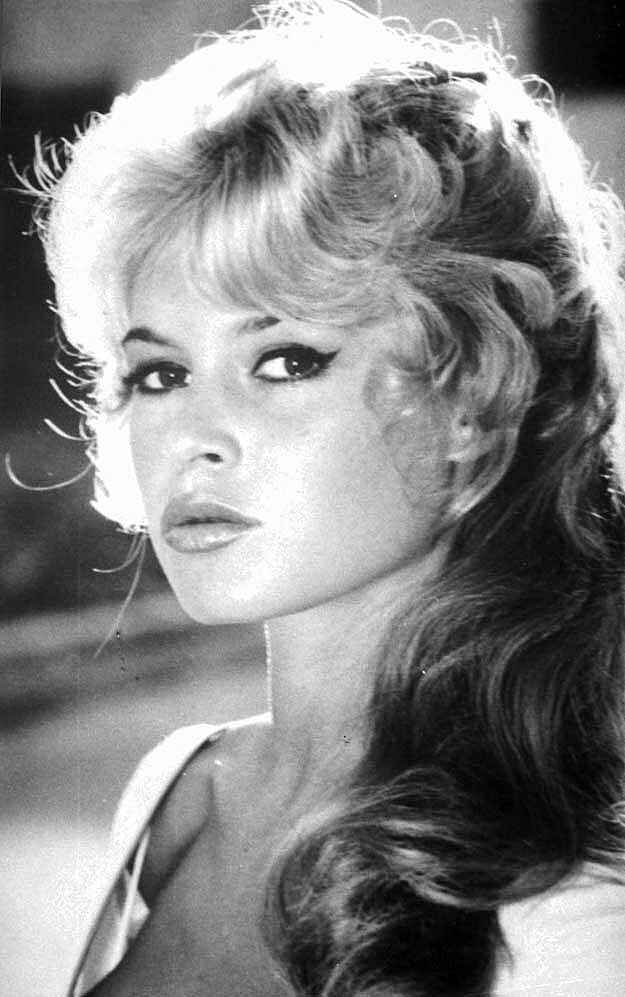
The French model, actress, singer and animal rights activist Brigitte Bardot (September 28, 1934—December 28, 2025) became a sensation in the United States in 1957 thanks to her film And God Created Woman (Et Dieu… créa la femme), released in France one year earlier, without commercial success. Roger Vadim (1928-2000) wrote and directed the film starring his then wife Brigitte Bardot, the daughter of a Catholic, bourgeois engineer and owner of the industrial Bardot factories in Paris.
As a teenager, Brigitte Bardot considers herself ugly. She wears braces, glasses, and has a slight squint. She suffers from her parents’ preference for her younger sister, Marie-Jeanne (*1938; known as “Mijanou”).
According to an interview with Jean Cau, also reported by her 2014 biographer Yves Bigot (Brigitte Bardot, la femme la plus belle et la plus scandaleuse au monde), Brigitte Bardot attributes her rebellious nature to the upbringing she received: “I was raised by conservative parents, members of the austere bourgeoisie, who gave me a fairly strict upbringing. I was familiar with the cane… I went to a Catholic school and was supervised by a governess. I never went out on the street alone. I was very restricted until I was 15.”
As a teenager, she has poor grades in school but, already at the age of 7, she wins first prize in dance in her class. In 1947, she is accepted into the Conservatoire national supérieur de musique et de danse de Paris in Jeanne Schwarz’s class (Catherine Rihoit: Brigitte Bardot, un mythe français, 2003). In 1950, she left the Conservatory to attend classes taught by Boris Kniaseff, a former dancer and choreographer at the Théâtre des Champs-Élysées and the Ballets Russes, where she meets the future actress and dancer Leslie Caron.
When Brigitte Bardot meets the future French filmmaker, producer and occasional actor Roger Vadim (1928-2000), she quits ballet. In 1948, her mother Anne-Marie Bardot convinces milliner and photographer Jean Barthet to have Brigitte participate in a fashion show presenting his hats. Subsequently, she becomes a junior model for the Virginie Jeune Fille fashion house, which offers college-style and sportswear outfits. Thanks to Pierre-André Tarbès, she becomes the face of Carven’s youth-oriented Ma Griffe perfume.
At age 13, a photograph of Brigitte is published in Jardin des modes, a chance encounter that launches her career as a magazine model. According to Catherine Rihoit, Brigitte’s family feared she would become a cover girl and fall into bad company. Permission to take the photos is granted during a family council meeting, on condition that she would not be paid and that her name would not appear. This is where the initials B.B. come from; her mother accompanies her to the photo shoots.
Hélène Lazareff, a friend of her mother’s and editor-in-chief of Elle magazine, notices Brigitte and choses her to appear on the cover of the May 2, 1949 special issue dedicated to young girls and their mothers, entitled Vos parents et vous, vos enfants et vous (Your Parents and You, Your Children and You). In mai 1950, Brigitte makes it onto the cover of Elle again.
In 1951, Christian Foye, a former principal dancer with the Ballets des Champs-Élysées, takes Brigitte on tour to Fougères and Rennes for a month for a ballet performance.
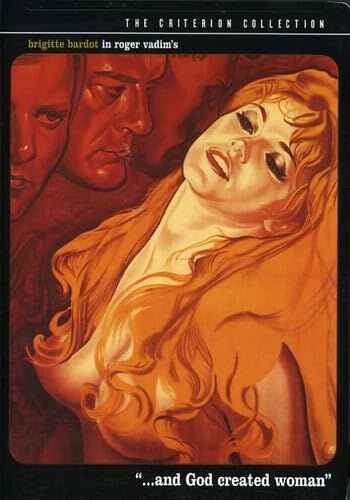
Accept cookies — we receive a commission; price unchanged — and order the DVD And God Created Woman (Et Dieu… créa la femme) from Amazon.com, Amazon.co.uk, Amazon.fr, Amazon.de.
Already in 1949, the French film director Marc Allégret, seeing one of her first photos in Elle magazine, asks to meet Brigitte, who is just a few days away from her 15th birthday. At the audition, she meets Allégret’s assistant, Roger Vadim, screenwriter of a film in preparation, Les lauriers sont coupés. The film is never made, but Bardot and Vadim become friends.
Her parents oppose this relationship and want to send Brigitte to boarding school in England for five years. Desperate, the young girl attempts suicide. Her father gives up on sending her abroad and agrees to let her continue seeing Vadim, forbidding him from marrying her before she turns 18.
In 1952, Brigitte Bardot has her first role in the film Le Trou normand, directed by Jean Boyer and starring the French actor and singer Bourvil. The three months of shooting are an unpleasant experience for her. Roger Vadim had told her that she was wrong to do this film. She accepted the role because the fee of 200,000 old francs enabled her to start a career and become independent, since she gave up her studies and dancing. After the filming of Le Trou normand, Brigitte travels to Megève with Roger without her parents’ knowledge for an abortion (Brigitte Bardot: Initiales B.B.: mémoires, 1996).
In 1952, Brigitte Bardot also stars in other forgetable movies such as Manina, la fille sans voiles by Willy Rozier and in Les Dents longues (1953), directed by Daniel Gélin, in which Roger Vadim has a small part as a wedding witness.
Bardot’s parents demand that Brigitte and Roger wait until her 18th birthday to get married. The civil wedding takes place on December 19, and the religious wedding on December 21, 1952.
In 1953, Bardot has a small part in Anatole Litvak’s movie Act of Love. The same year, she stars in the théâtre de l’Atelier in Paris in the piece L’Invitation au château, written by Jean Anouilh. According to Catherine Rihoit, most reviews regarding the performance by Brigitte are positive. Subsequently, she has a small part in Sacha Guitry’s movie Si Versailles m’était conté…
In Rome, Brigitte Bardot plays the part of Andraste, Helen’s (Rossana Podestà) handmaiden in the film Helen of Troy (1956) by the American director Robert Wise. Still in Rome, she co-stars as Anna in Concert of Intrigue (1954), shot by the Italian filmmaker Mario Bonnard.
Back in France, Brigitte is offered a smaller part in René Clair’s Les Grandes Manœuvres (1955). She stars in the film Plucking the Daisy (En effeuillant la marguerite, 1956), directed by Marc Allégret and co-written by her husband, Roger Vadim. Back in Rome, she co-stars as Poppaea in Nero’s Mistress (1956), directed by Steno (Stefano Vanzina).
And now we’re back at the beginning of this article with the movie And God Created Woman (Et Dieu… créa la femme), which makes her a star and an international sex-symbol. In addition, it destroys her marriage because, on the set, she falls in love with her co-star Jean-Louis Trintignant.
According to Samuel Blumenfeld in Le Monde (2021), the film flops in France. In three weeks of release, the film grosses only 60 million old francs, while it cost 140 million to produce. But, as mentioned above, And God Created Woman is a huge success in the United States. Subsequently, the film is re-released in France and becomes a resounding success.
In addition, the movie creates the myth Saint-Tropez. The former fishing village is already known thanks to Neo-Impressionists such as Paul Signac and later painters such as Matisse, Pierre Bonnard and Albert Marquet, but Brigitte Bardot takes the notoriety of the small Mediterranen Sea port into a whole new dimension.
Thanks to Bardot, the port becomes a hot spot for toplessness. The mayor of Saint-Tropez orders police to ban it and to watch over the beach via helicopter. The “clothing fights” between the gendarmerie and nudists become the main topic of the French comedy film series Le gendarme de Saint-Tropez featuring Louis de Funès. In the end, the nudist side prevails.
As for Bardot’s first marriage, it ends in divorce on December 6, 1957. Despite that fact, she stars in Les Bijoutiers du clair de lune (1958), Please, Not Now! (La Bride sur le cou, 1961), Love on a Pillow (1962), Spirits of the Dead (1968), Don Juan, or If Don Juan Were a Woman (1973) all directed by Roger Vadim. Don’t feel pity for him. Among his later lovers and wives are the likes of Catherine Deneuve and Jane Fonda, to mention just the two most famous names.
As for Brigitte, she does not mary Jean-Louis Trintignant, who had left his wife (married in November 1954), actress Stéphane Audran, to live with Bardot. In 1957, while doing his military service, Jean-Louis Trintignant ends their relationship after discovering that Brigitte Bardot has an affair with the singer Gilbert Bécaud, followed by another short fling with the singer Sacha Distel.
In 1958, Brigitte Bardot buys her famous seaside property La Madrague in Saint-Tropez, which she keeps until her death.
On June 18, 1959 Brigitte Bardot marries actor Jacques Charrier. But her second marriage does not last long. In 1960, Sami Frey is the partner of the actress Pascale Audrey, whereas Brigitte Bardot is still married to Jacques Charrier, with whom she has her one and only child, Nicolas-Jacques, born on January 11, 1960. But after the shooting of the French movie La Vérité in 1960, starring Sami Frey and Brigitte Bardot, the two leave their partners and form a couple, which lasts three years.
Interestingly, it is only on January 30, 1963 that the divorce between Bardot and Charrier is pronounced. Jacques is granted custody of their son, whom he is raising with his new wife, France Louis-Dreyfus. Bardot lacks the maternal gene. During the pregnancy, she thinks about another abortion. But she is too famous for any doctor to take the risk of such an illegal action. In her memoirs, Brigitte Bardot writes: “My pregnancy was nine months of hell. It was like a tumor that fed off me, that I carried in my swollen flesh, just waiting for the blessed moment when it would finally be removed.”
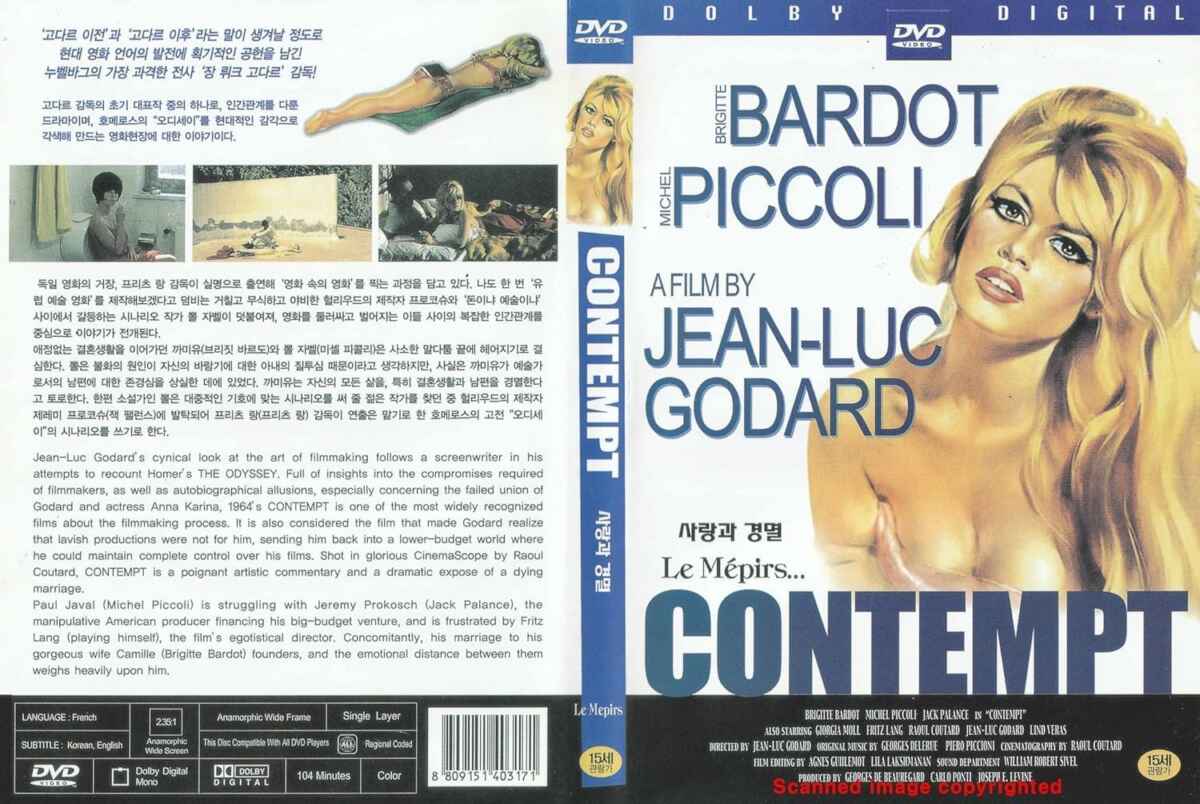
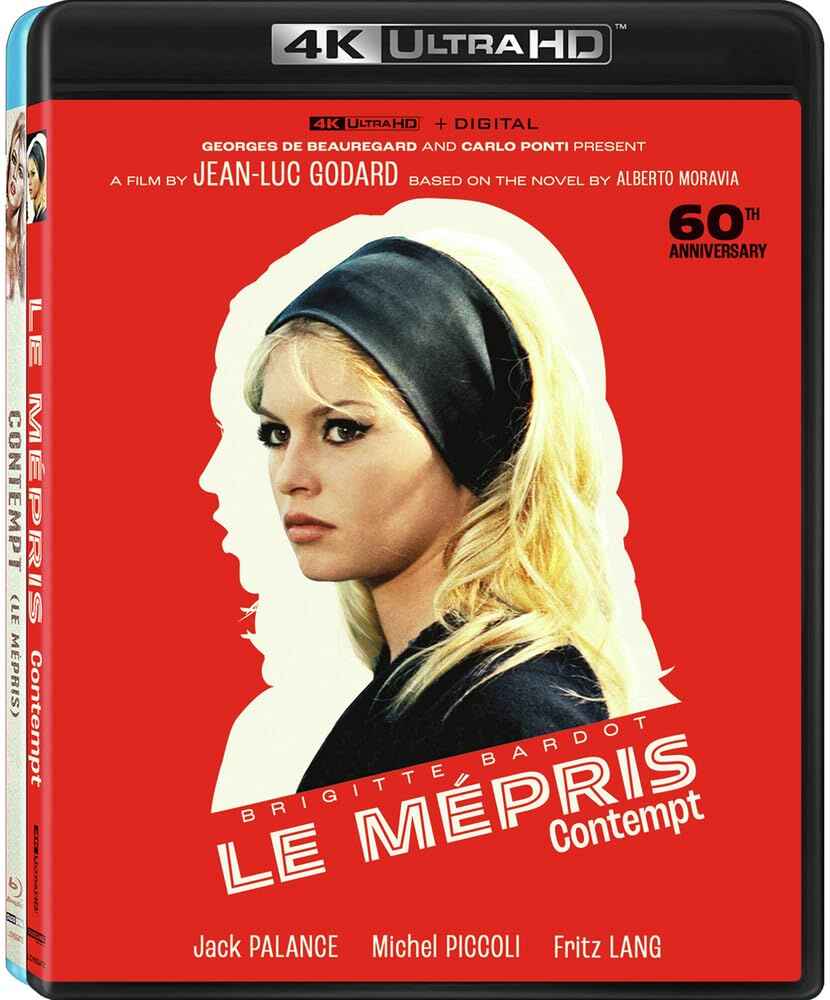
Accept cookies — we receive a commission; price unchanged — and order the DVD Contempt (Le Mépris) from Amazon.com, Amazon.co.uk, Amazon.fr, Amazon.de.
In 1963, Brigitte Bardot shoots the famous film Contempt (Le Mépris), directed by Jean-Luc Godard, based on Alberto Moravia’s 1954 novel Il disprezzo. According to Variety, half the film’s budget goes to Bardot’s fee. Le Mépris is a success with the public, critics and intellectuals alike. The Swiss TV channel RTS writes that her screen presence, characterized by naturalness, spontaneity, and boldness, has a lasting influence on European cinema and contributes to changing the representation of women, who are now able to express their desires, freedom, and fragility without being confined to stereotypes.
During the shooting of Le Mépris, Bardot leaves Sami Frey. The young Parisian actress is single and available. She begins a new romance with the former Brazilian Flamengo basketball player, turned poker player and future film producer of Moroccan origin, Bob Zagury, with whom she goes on vacation to Rio de Janeiro. After facing over 200 photographers and journalistes, she flees to the peninsula Armação dos Búzios, which she helps transform into a tourist hotstop. In her 1996 autobiography Initiales B.B., she writes that it was probably in Búzios that she had spent the happiest days of her life.
In 1965, Brigitte Bardot and Jeanne Moreau shoot the adventure-comedy Viva Maria! in Mexico, directed by Louis Malle. Later in the 1960s, she turns down parts in the James Bond movie On Her Majesty’s Secret Service as well as in the The Thomas Crown Affair (finally starring Steve McQueen and Faye Dunaway).
On July 14, 1966 the French national holiday, just after one month of courtship, during which Gunter Sachs sends her some 10,000 roses by helicopter, which are dropped onto her villa, Brigitte Bardot and the German industrialist Gunter Sachs fly to Las Vegas to get married. According to rumors, the notorious playboy Sachs bet his friends that he could marry the famous movie star.
Bardot invests herself in this relationship like never before. But it turns out to be a rocky one too. In 1967 she performs the song Harley-Davidson, composed by Serge Gainsbourg. She becomes his muse and begins an extramarital affair with the singer-composer. Gunter Sachs also has affairs on the side.
With Gainsbourg, Bardot is recording a version of Je t’aime… moi non plus (45 rpm & maxi 45 rpm). The scandalous 1967 duet was not released until 1986. The version that makes it into the charts is the one by actress and singer Jane Birkin. For the first time, Bardot takes a step back to save her marriage to Gunter Sachs. But the effort is unsuccessful. On October 1, 1969 her third marriage ends in her third divorce.
In 1968, Brigitte Bardot stars in the Western Shalako opposite Sean Connery, directed by Edward Dmytryk. Reviews are mixed. I would say that Sergio Leone’s Western shot during that period were much better.
In 1968, Bardot is chosen to be the model for the bust of Marianne, the national personification of the French Republic which sits enthroned in town halls across France. By accepting, she becomes the first actress to lend her features to the French symbol. The bust is created by the sculptor Aslan (Alain Aslan Gourdon).
In 1969 follows the sex comedy Les Femmes (released in the United States as The Vixen), co-written and directed by Jean Aurel, starring Brigitte Bardot and Maurice Ronet. In 1970, together with Jean-Pierre Cassel, she stars in the romantic comedy The Bear and the Doll, directed by Michel Deville. Nothing to write home about.
The same has to be said about The Beginner (French: Les Novices), a 1970 movie directed by Guy Casaril about nuns (Brigitte Bardot, Annie Girardot) on the beach. The Rum Runners, directed by Robert Enrico, starring Lino Venturo and Brigitte Bardot, is not a great success. Popular acclaim comes again with the celebrated western comedy The Legend of Frenchie King (French title: Les Pétroleuses, 1971), directed by Christian-Jaque, starring BB and CC, that is Brigitte Bardot and Claudia Cardinale, another famous actress who passed away in 2025.

Accept cookies — we receive a commission; price unchanged — and order the DVD Les Pétroleuses (The Legend of Frenchie King) from Amazon.com, Amazon.co.uk, Amazon.fr, Amazon.de.
The Edifying and Joyous Story of Colinot (1973), directed by Nina Companeez, is Brigitte Bardot’s last film. It is not notable because she plays a medieval chatelaine in a film set in the Périgord countryside. It is notable because, in one scene, she sees an old lady walking a small goat on a leash. She approaches her to stroke the animal, and the lady tells her that it is destined for a barbecue to celebrate her grandson’s communion the following Sunday. Horrified, Brigitte Bardot buys the goat, puts it in her caravan, and returns to her hotel in Sarlat with it that evening. She settles it into her room with the little dog she has also just adopted.
This incident, which happens on June 6, 1973 when she is 38, is considered to be the trigger for Brigitte Bardot to stop her film career and dedicate herself to the cause of animal rights the rest of her life.
Brigitte Bardot’s destiny is closely related to the one of Franz Weber (1927–2019), a Swiss environmentalist and animal rights activist, who studied at the Sorbonne University in Paris. He establishes the Franz Weber Foundation in 1975.
In 1976, Brigitte Bardot joins Franz Weber’s fight against the annual seal hunt on the coast of Labrador in Canada. In 1983, the European Economic Community banns all imports of baby seal skins into the EEC. But in an interview 30 years later, Bardot deplores that the seal hunting is still going on, that the hunters are actually butchers.
In 1987, Brigitte Bardot auctions off a large number of personal items to finance her own animal welfare foundation. She campaigns for the rights of domestic, wild and circus animals. Among the objects are her Marianne statue, her guitar, her Roger Vadim wedding dress, jewelry that Gunter Sachs gave her, and he buys it back to give it to her again. In 1992, the Fondation Brigitte Bardot is granted public interest status.
It is at a 1992 dinner party hosted by her lawyer, Jean-Louis Bouguereau (or by Jany Le Pen, according to another source) in Saint-Tropez that Brigitte Bardot meets Bernard d’Ormale, an industrialist and advisor to the far-right politician Jean-Marie Le Pen. This fourth and final mariage lasts until her death at the end of 2025. “It was love at first sight for both of us”, she later wrote; they get married on August 16, 1992.
Since then, Brigitte Bardot has repeatedly embraced far-right ideas, issued anti-Muslim, anti-immigration, xenophobe and homophobe statements, altough she repeatedly claimed that she did not share all of the Front national’s (FN; today’s Rassemblement national, RN) ideas, especially regarding abortion.
She calls the former president Chirac “the king of liars”, and says that she likes Marine Le Pen very much. Regarding Brigitte Bardot’s political positions, let’s not forget that in 1958 and later, she has been fond of Charles de Gaulle and, even later, of the liberal president Valéry Giscard d’Estaing.
In a 2005 TV interview, Brigitte Bardot said: “This is no longer my France […]. France used to be a beautiful country, but now everything is going to hell. Integration is disintegration; things are too far apart: cultures, traditions, religions […] cannot get along.” She added: “I am never an extremist. Not in one direction or the other. There is no more right wing. […] Chirac’s right wing is no longer a right wing [La droite de Chirac n’est plus une droite].”
The future far-right politician, back then just a young soldier, Jean-Marie Le Pen, and Brigitte Bardot quickly meet in 1954, when the young actress visits French soldiers injured in Algeria. They only become friends in the 1990s. On the ties that bind them, see Antoine de Baecque: Bardot, Paris, Les Pérégrines, 2025, pages 147–153).
In 1997, when the far-right politician Bruno Mégret is disqualified for “failing to comply with campaign financing regulations”, his wife, Catherine, replaces him at short notice as a candidate for mayor of Vitrolles. She was elected on February 9, 1997, with 46.70% of the vote in the first round and 52.48% in the second, benefiting in particular from the spectacular support of Brigitte Bardot.
In the 2012 French presidential election, Brigitte Bardot openly calls for people to vote for Marine Le Pen, who ends up third with 17,9%. Until her death, the former actress has been in support of Marine Le Pen.
In addition, she is more than once in support of the Parti animaliste (PA), created in 2016. For instance for the 2024 European elections, she calls for people to vote for the Animalist Party, publicly stating that it is the only party that wants to promote animal welfare.
In her octobre 2025 book Mon BBcédaire, Brigitte Bardot writes that France has “become dull, sad, submissive, sick, damaged, ravaged, ordinary, vulgar…“ She concludes that the (far-) right is the ”only urgent remedy for France’s agony”. She also notes: “Freedom is being yourself, even when it’s uncomfortable.”
Between 1952 and 1973, Brigitte Bardot appears in 47 films (not all of them mentioned above). In addition, she performs in several musicals and records more than 60 songs until 1982. Her last single is entitled “All Animals Are to Be Loved” (Toutes Les Bêtes Sont à Aimer).
Brigitte Bardot in 1958. Photo copyright: Landesarchiv Baden-Württemberg, Staatsarchiv Freiburg W 134 Nr. 036134b. Photographer: Willy Pragher (via Wikimedia/Wikipedia).
A part from the biographies and interviews mentioned in the text, the French Wikipedia entry about Brigitte Bardot, which is much more detailed, was very helpful for writing this article.
Obituary added on January 3, 2026 at 17:40 German time. Updated at 21:09.


