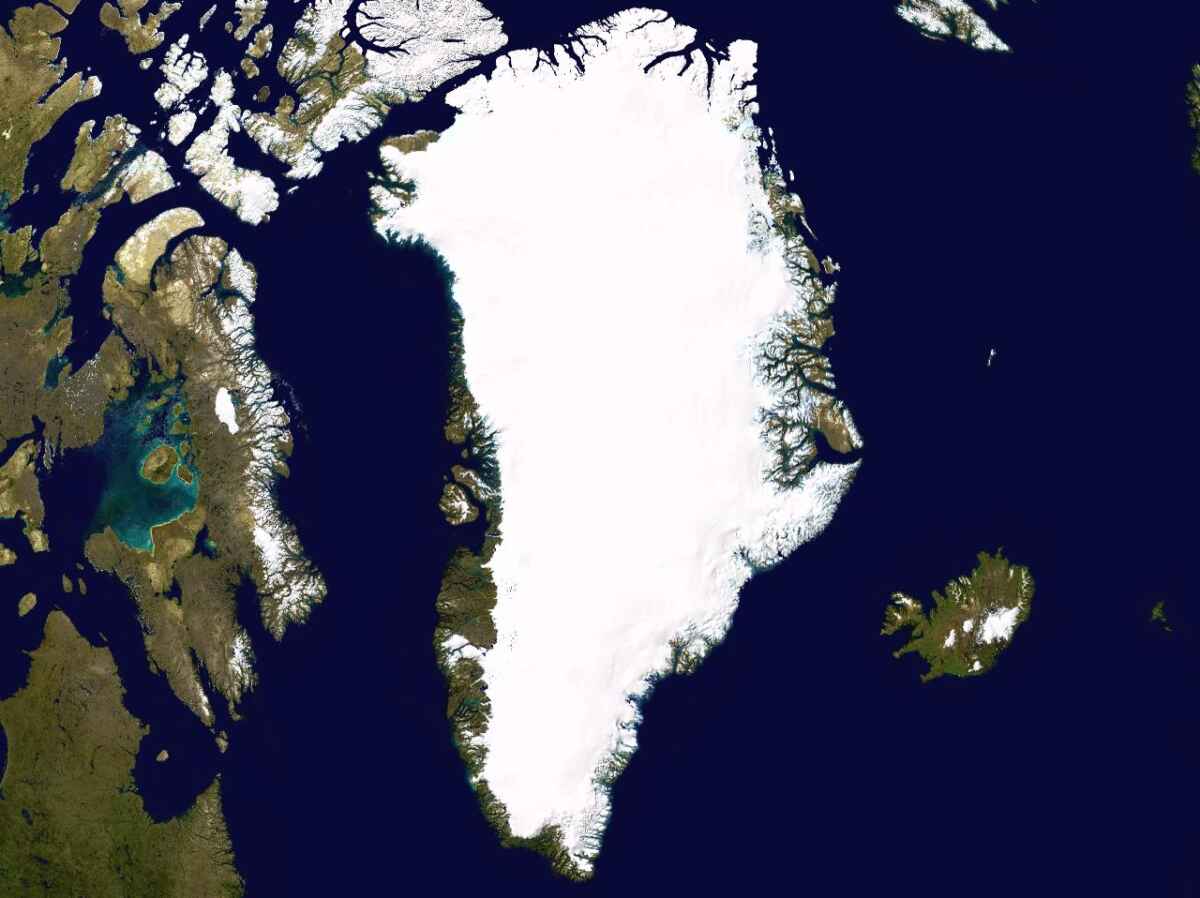
Donald Trump is not the first U.S. president to want to buy Greenland. But he went even further and repeatedly did not rule out the use of force. On January 9, he stated: “I would like to make a deal, you know, the easy way, but if we don’t do it the easy way, we’re going to do it the hard way.” On January 11, the president said that the United States would take Greenland “one way or another”.
However, today, January 21, at the World Economic Forum in Davos (Switzerland), in front of a large number of political and economic world leaders, Donald Trump ruled out the use of military force: “We probably won’t get anything unless I decide to use excessive strength and force where we would be, frankly, unstoppable. But I won’t do that. That’s probably the biggest statement, because people thought I would use force. I don’t have to use force. I don’t want to use force. I won’t use force. All the United States is asking for is a place called Greenland.”
But he has not backed down from his threat to impose an additional 10% tariff on February 1st on Denmark, Norway, Sweden, France, Germany, the UK, the Netherlands and Finland, unless the United States were allowed to buy Greenland. If his demand where not met by June 1st, the additional tariff on goods from the eight countries mentioned above would increase to 25%. [Update at 23:03 Trump backed down, Trump waives new tariffs on Greenland].
Why does Trump now rule out the use of military force? NATO soldiers cannot attack other NATO soldiers without provoking the end of the North Atlantic Treaty Organization, which is a vital instrument of U.S. foreign and military policy. Maybe Trump also stepped back because of an Ipsos/Reuters poll conducted on January 12 and 13, 2026. It revealed that 66% of respondents, including 91% of Democrats and 40% of Republicans, said they were worried U.S. efforts to acquire Greenland will damage the NATO alliance and U.S. relationships with European allies. Only roughly 10% of respondents agreed that the United States “should use military force to obtain new territory, like Greenland and the Panama Canal”. 71% of all adults (including 60% of Republicans and 89% of Democrats) said it would not be a good idea for the United States to use military force to acquire Greenland.
In addition, a CBS News and YouGov poll, conducted from January 14 to 16, CBS showed that 70% of Republicans, 97% of Democrats and, overall, 86% of all adults were against President Trump using military force to take control of Greenland, a semi-autonomous territory belonging to Denmark, a NATO ally. Asked about the use of federal funds to purchase Greenland, 64% of Republicans were in favor, but 75% of independents and 96% of Democrats were opposed to the idea. Overall, 70% percent of U.S. adults oppose a plan to purchase the territory from Denmark. The polls margin of error: plus or minus 2.3 percentage points.
Not all Republicans in the Senate and the House of Representatives approve the mobster-style initiatives regarding Greenland by President Trump. On January 13, U.S. Senators Jeanne Shaheen (D-NH) and Lisa Murkowski (R-AK) introduced the NATO Unity Protection Act, bipartisan legislation to prohibit the use of U.S. Department of Defense or Department of State funds to blockade, occupy, annex or otherwise assert control over the sovereign territory of a NATO member state without that ally’s consent or authorization from the North Atlantic Council, and to reaffirm the United States’ commitment to NATO unity and collective security.
On January 17, the Republican Senators Thom Tillis (R-N.C.) and Lisa Murkowski (R-Alaska) slammed President Trump’s new 10% tariffs on eight NATO members (Denmark, Finland, Norway, Sweden, the Netherlands, the United Kingdom, France and Germany), who had sent a few soldiers to Greenland in a show of support for the territory, officially to demonstrate that these NATO members were ready to defend Greenland against possible threats (from China and Russia, obviously also from the United States).
President Trump is surrounded by yes-men, including dangerous right-wing hawks such as Stephen Miller, the White House deputy chief of staff for policy and homeland security advisor. On January 5, Stephen Miller told CNN’s Jake Tapper: “We are going to conduct ourselves as a superpower. We live in a world in which you can talk all you want about international niceties and everything else, but we live in a world, in the real world, Jake, that is governed by strength, that is governed by force, that is governed by power.”
The retiring U.S. representative for Nebraska’s 2nd congressional district, Don Bacon, who does not have to fear Trump’s attacks because he will not run again, called Stephen Miller’s comments “really dumb.” On X, Stephen Bacon wrote: “There is no up side to demeaning our friends. But, it is causing wounds that will take time to heal.”
So far, Donald Trump got away with anything. But attacking a NATO ally would be a step to far. In addition, the infamous Epstein Files are far from being fully released; on January 6, the Justice Department estimated it had released less than 1% of the Epstein-related documents. That’s another subject that could hurt the president. According to a CNN online and phone poll conducted from January 9 to 12, only 6% of Americans are satisfied with how the Trump administration has handled the release of Epstein-related documents. 49% say they’re dissatisfied with how the administration has handled the release. 67% of Americans believe the government is intentionally holding back information that should be made public.
Apart from the fact that the United States of America emerged from former European colonies, after its Declaration of Independence in 1776, the US repeatedly conquered or purchased territories and made several attempts to acquire Greenland.
During the 19th century in particular, the USA expanded continuously from the former 13 colonies on the east coast to become a territorial and economic superpower covering large parts of North America from the east to the west coast. The so-called American Indian Wars or American Frontier Wars were part of this phase of expansion.
The Spanish, French, Dutch, and English conquered and colonized areas that are now part of the United States. After independence, the United States purchased the territory of what is now the state of Louisiana from the First French Republic in 1803 (Treaty of Guadalupe Hidalgo) for $15 million at the time.
With the Monroe Doctrine of 1823, then-President James Monroe called for an end to European colonial ambitions in North, Central, and South America, while at the same time announcing U.S. intervention if Europeans failed to comply with these principles. In addition, James Monroe stipulated that the United States would not interfere in European conflicts.
In 1845, the USA annexed Texas from Mexico. After the Mexican-American War of 1846-48, Mexico had to cede around 55% of its territory (1.36 million square kilometers) to the USA, including the territories of the present-day states of California, Nevada and Utah, most of Arizona, Colorado and New Mexico as well as a small part of Wyoming.
In addition, Mexico had to accept the Rio Grande as the southern border of Texas. In return, the United States government paid Mexico $15 million at the time, which covered, among other things, debts owed by the Mexican government to U.S. citizens. The Mexicans in the purchased or conquered territories could choose to move to Mexico or become citizens of the United States, with all rights.
In 1854, the United States purchased another $10 million worth of territory from Mexico, which is now part of the states of Arizona and New Mexico (English: Gadsden Purchase/Spanish: Venta de La Mesilla).
In 1867, the United States purchased the territory of what is now the state of Alaska, covering approximately 1.6 million square kilometers, from the Russian Empire for $7.2 million. Alaska did not become a U.S. state until 1959.
In 1898, the USA annexed the (former) Kingdom of Hawaii, which also only became a U.S. state in 1959. In 1898, after the Spanish-American War, Guam, Cuba, the Philippines, and Puerto Rico became (temporary) American colonies, with Puerto Rico remaining a so-called external territory of the United States to this day without becoming a U.S. state.
In 1917, the United States purchased the Danish West Indies (Danish: Dansk Vestindien or Danske Jomfruøer), now known as the United States Virgin Islands, which brings us to the Danes and the USA.
The United States had already attempted to purchase Danish West India in 1868—the U.S. Congress voted against it—and again in 1902. Today, Greenland is an autonomous, i.e., self-governing territory of the Kingdom of Denmark, with its own prime minister. The area, which was already settled around 2500 years ago, has been linked to Denmark and Norway since 986; Denmark had to cede Norway to Sweden in the Treaty of Kiel in 1814. Greenland was gradually colonized by Denmark over centuries, with the Kingdom of Denmark only declaring its sovereignty over Greenland in 1921, despite Norway’s objections. In 1933, the Permanent Court of International Justice in The Hague ruled that the whole of Greenland belonged to Denmark.
During World War II, Denmark was occupied by Nazi Germany in 1940 and cut off from Greenland. As a result, the Danish envoy to the U.S. stopped taking orders from Copenhagen in 1941 and approved the construction of U.S. military bases in Greenland, which were strategically important for refueling U.S. aircraft during World War II. The US maintained up to 17 military bases there. Today, the United States is the only power that maintains a military base in Greenland (Pituffik; known as Thule Air Base until 2023). Today, around 150 US Americans are still stationed there. During the Cold War, there were up to 10,000 troops.
As early as 1868, the US attempted to purchase Greenland and Iceland from Denmark for $5.5 million in gold, but in the end, Secretary of State William H. Seward did not make an offer to the Danes. According to historians, this was probably because the aforementioned treaty to purchase the Danish West Indies had not gained majority support in the US Congress.
In 1910, the U.S. government once again discussed the purchase of Greenland internally. Some “prominent” Danes had apparently suggested to the US ambassador in Denmark that the US-owned Philippine islands of Mindanao and Palawan be exchanged for Greenland and Danish West India, which would then have allowed Denmark to exchange Mindanao and Palawan with the Germans for part of Jutland on the German-Danish border.
In 1946, the Truman administration secretly offered the Danes $100 million in gold for the purchase of Greenland. The Danes declined, but were unable to secure the withdrawal of U.S. troops from Greenland. In 1951, the two governments signed the Greenland Defense Agreement, which allowed the United States to establish additional military bases in Greenland as long as the NATO treaty remained in force; NATO was founded in 1949.
The Thule Air Base, which played an important role during the Cold War, was built in 1953. In 1955, the Joint Chiefs of Staff again proposed the purchase of Greenland to President Eisenhower, but the State Department rejected the proposal by the US military leaders. No offer was ever made.
In 1976, Gerald Ford’s Vice President Nelson Rockefeller (privately) again proposed acquiring Greenland, citing the island’s natural resources as the reason for the purchase.
During his first term in office, President Trump first said in 2019 that he wanted to buy Greenland. According to a 2022 NYT article by Peter Baker, the idea came from Ronald S. Lauder, the New York cosmetics heir who had known Mr. Trump since college. “A friend of mine, a really, really experienced businessman, thinks we can get Greenland”, Donald Trump told his national security adviser. “What do you think?” That led to a special team being assigned to evaluate the prospects, resulting in a memo that laid out various options, including a lease proposal akin to a New York real estate deal.
In his second term, President Trump has repeated this claim several times, sometimes referring to a purchase, sometimes to other means of acquisition, thus not ruling out (forcible) annexation. Even before taking office, on December 22, 2024, Donald Trump announced: “For purposes of National Security and Freedom throughout the World, the United States of America feels that the ownership and control of Greenland is an absolute necessity.”
Greenland is part of Denmark and NATO. Greenland is not currently threatened by China or Russia. However, it is true that since 2017, China has viewed the Arctic as part of its global strategy to secure transport infrastructure. Putin is active in the Arctic and is attempting to extend Russia’s control. Trump wants Greenland for strategic reasons.
As mentioned above, the only military base on the island is operated by the United States. Among other things, it serves as a warning system against ballistic missile attacks. It can also function as an “aircraft carrier.” If the region becomes ice-free in the summer due to global warming, it would become important for maritime trade. The U.S. wants to control the waters of this strategically important region. Trump is also interested in Greenland’s raw materials.
In addition to oil and gas, 37 of 50 minerals classified as strategically important by the United States can be found on the island. However, most of these raw materials lie beneath thick layers of ice. Mining would be difficult and expensive unless global warming makes access easier. The island also lacks the necessary infrastructure.
The relationship between the 57,000 Greenlanders living there today and the former Danish colonial rulers is strained. This is partly due to the fact that Denmark mined cryolite, an important raw material for aluminum production, in Greenland for a good 130 years through the state-owned Danish Cryolite Company. According to the documentary Greenland’s White Gold, Denmark earned an estimated €53 billion from this, none of which went to the Greenlanders.
In addition, in the 1960s, the Danes considered the birth rate in Greenland to be too high and fitted 4,000 women and girls aged 12 and over with intrauterine devices, although not all of them were informed about the health consequences, and some girls were not even told what was happening to them.
Many Greenlanders dream of independence. Following a referendum in 2009, which was approved by the Danish Parliament, the Self-Government Act allows the island to become independent. Today, this is not yet financially possible, as 54% of Greenland’s budget is covered by Denmark and the European Union.
During Trump’s second term in office, the United States is agitating so strongly against its loyal NATO partner Denmark, including through covert operations, that the British, Germans, French, Italians, Poles, Spaniards, and Danes felt compelled to publish a joint statement on January 6, 2026, in which they stated that Denmark and Greenland alone would decide on matters affecting Denmark and Greenland. They also emphasized the importance of Greenland’s “sovereignty, territorial integrity, and inviolability of borders”, those principles that NATO invokes in connection with the defense of Ukraine against Russian aggression, as a NYT article rightly remarked.
The Greenlanders want to become independent in the long term, but they do not want to be bought or annexed by the USA. According to a survey conducted by the opinion research institute Verian on behalf of the Greenlandic newspaper Sermitsiaq and the Danish newspaper Berlingske at the end of January 2025, only 6% of Greenlanders wanted to join the US, 9% were undecided, and the overwhelming majority of 85% were against it.
Around 45% of Greenlanders saw Trump’s interest in Greenland as a threat, around 43% as an opportunity, and around 13% were undecided. The survey was based on a poll of 497 Greenlanders over the age of 18. The margin of error was stated as 1.9% to 4.4%.
President Trump has threatened to take back the Panama Canal, which was once built by the U.S. but has long since been ceded to Panama under treaty. He has repeatedly made threats against Canada—as a possible 51st state of the US. Trump’s preference for dictators like Putin and illiberals like Orban, who has severely damaged Hungary’s democracy, is well known. In the USA, Trump refused to recognize Joe Biden’s fair and free election win, wanted to remain in office and sent a mob to the Capitol.
In Venezuela, Trump did not intervene to restore democracy, but to gain control of the world’s largest oil reserves; U.S. corporations had once been expropriated in Venezuela and never compensated for it. Trump may have brought Maduro and his wife to the United States in a spectacular intervention. Maduro is now on trial, but his former vice president Delcy Rodríguez is the new ruler in Venezuela. For most people in the impoverished country, nothing is likely to change.
The November 2026 midterms are an enormously important milestone for the future of the United States. The Democrats must weaken the Trump Republicans so that the wannabe autocrat, surrounded by yes-men, cannot further undermine American democracy—and with it, the free world as a whole.
The history of all the territories, colonies, wars, etc. mentioned above is, of course, much more complicated than presented here. It fills entire bookshelves. One fact stands out: Trump is not the first U.S. president who wants to buy, conquer, or annex Greenland or other territories.
Advertisements (accept cookies; we receive a commission, price unchanged):
Luggage and suitcases at Amazon.com, Amazon.de, Amazon.fr, Amazon.co.uk
Beauty items at Amazon.com and Amazon.co.uk
NASA satellite photograph showing Greenland/Groenland. Photo: public domain (via Wikipedia).
Article added on January 21, 2026 at 22:28 German time. Update at 23:03 Trump waives new tariffs on Greenland.


