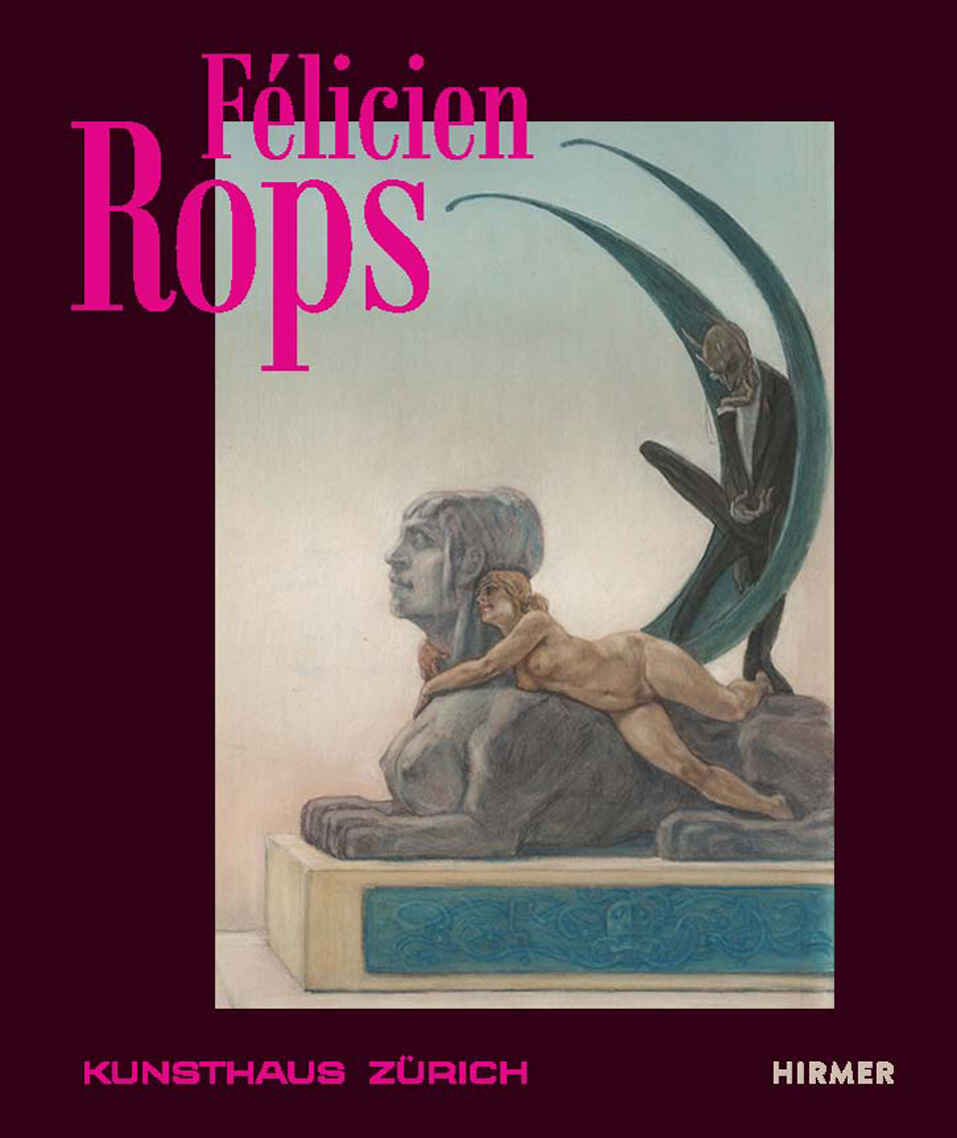
Even in today’s sexualized world, the erotic and pornographic works of the master of Belgian Symbolism, Félicien Rops (1833–1898), have the power to lure audiences out of their comfort zones. They transgressed every boundary of art. With a keen eye and a sharp pen, with irony, provocation and graphic precision, the son of the wealthy textile merchant from the city of Namur Nicolas Joseph Rops and his wife Sophie exposed the hypocrisies and double standards of bourgeois society.
Already since March 6 and until May 31, 2026 the exhibition Félicien Rops. Laboratory of Lust at Kunsthaus Zürich, conceived and curated by Jonas Beyer (Kunsthaus Zurich) and Daan van Heesch (Royal Library of Belgium, KBR), developed in close cooperation with the KBR, presents some 70 works from international collections.
The bilingual (German and English) catalog, edited by Jonas Beyer, Zürcher Kunstgesellschaft/Kunsthaus Zürich, Daan van Heesch: Félicien Rops. Laboratory of Lust, Hirmer, 2026, 208 pages with 93 illustrations, 23 x 27 cm, 9 x 11 inches, paperback with flaps. ISBN: 978-3-7774-4748-3. Accept cookies — we receive a commission; price unchanged — and order the bilingual English/German edition from Amazon.com, Amazon.co.uk, Amazon.fr, Amazon.de.
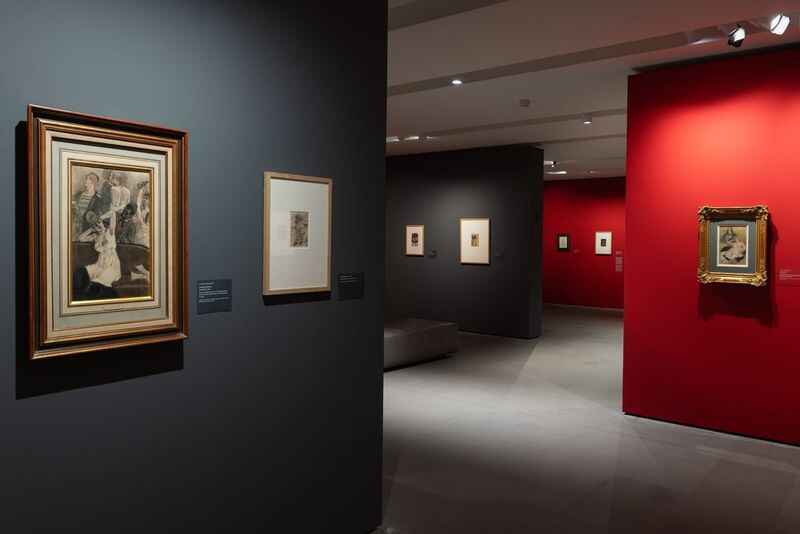
View of the Félicien Rops exhibition in Zurich. Photo copyright © Kunsthaus Zürich.
After studying art in Naumur and law and art in Brussels, Félicien Rops initially worked the Belgian capital and later in Paris as a politically engaged caricaturist in the style of Honoré Daumier, only to then depict the hardships of rural life with the realism of Gustave Courbet (don’t miss the Courbet exhibition at Leopold Museum in Vienna until June 21, 2026). Already in 1851, Félicien Rops had discovered the realism of Courbet, who had presented his painting The stone breakers (Les Casseurs des pierres) in Brussels.
In the catalog, you can find a conversation between Véronique Carpiaux, Chief Curator of the musée Félicien Rops in Namur and the Kunsthaus exhibition curator Jonas Beyer, in which Véronique Carpiaux illustrates how, in Rops’s work, caricature and realism were not always mutually exclusive.
The Kunsthaus Zürich Director Ann Demeester underlines in her catalog Foreword that the Belgian artist found his actual life’s theme in the French capital: the women of the Parisian demi-monde, those Parisiennes for whom he ultimately coined the possessive term Ropsiennes.
According to the Kunsthaus director, all these themes have a common core: they reflect the artist’s self- imposed obligation to portray his own time unsparingly. Rops saw the women on the boulevards of Paris as the epitome of the modern age. His stylisation of women as femmes fatales, combining attraction and horror, was typical of the time.
According to Véronique Carpiaux, inspired by the literature of Décadentisme, Rops drew the femme fatale, a woman who makes men dance like puppets, using her powers of attraction to do with them as she pleases.
In her catalog contribution, the art historian and project curator at Kunsthalle München, Juliane Au, reflects on how this social climate was not least related to the increasing blurring of social boundaries. Rops took this combination of eroticism and horror to extremes on more than one occasion. This earned him a certain reputation: the most poisonous flower of Symbolism, bogey of the bourgeoisie, enfant terrible.
In 1857, Félicien Rops married Charlotte Polet de Faveaux, the daughter of the president of the Court of Namur. Juliane Au stresses that this gave the artist complete financial security and independence. He was able to pursue his art without any significant financial worries. Despite the anti-conformist views expressed in his critical works, he cultivated an haute bourgeois lifestyle. He continued to have several affairs, some of which became public knowledge. Consequently, the couple lived apart from 1875 onwards, but Charlotte refused to divorce him. They remained married until his death.
Juliane Au mentions that, subsequently, Félicien Rops started an affair with the sisters Léontine and Aurélie Duluc, who ran a highly successful fashion house specializing in haberdashery, which repeatedly appeared in Rops’s works for promotional purposes.
Rops was renowned for his bluntly sexual depictions of naked women and ambiguous situations that always addressed the bourgeoisie itself. The motif of the (undressed) woman was used to address the moral issues and deep-seated social fears of the time. in Ecce diabola mulier, the devilish woman is depicted as a half-skeleton, half-human figure in a corset and mask, unabashedly presenting her pubic bone. With her focus on sex, she became a mainstay in Rops’s pictorial world, according to Juliane Au.
The contribution also mentions the image of the progressive ‘Parisienne’ as portrayed in advertising: a self- confident, fashionably dressed woman who enjoyed new freedoms. This led to a widespread perception that bourgeois women and prostitutes were becoming increasingly similar. There was a growing insecurity on the part of men towards women – behind every seemingly respectable woman, they feared, could be a concealed prostitute. This presented both a moral dilemma and a real health risk (syphilis).
In the mid-19th century, Paris counted an estimated 50,000 prostitutes in a city with a population of one million people. According to that count, one in ten women had sex for money – and that number includes babies and grandmothers! The musée d’Orsay exhibition Splendour and Misery. Pictures of Prostitution, 1850-1910 from September 22, 2015 until January 17, 2016 offered a look at the different levels of sex work in Paris.
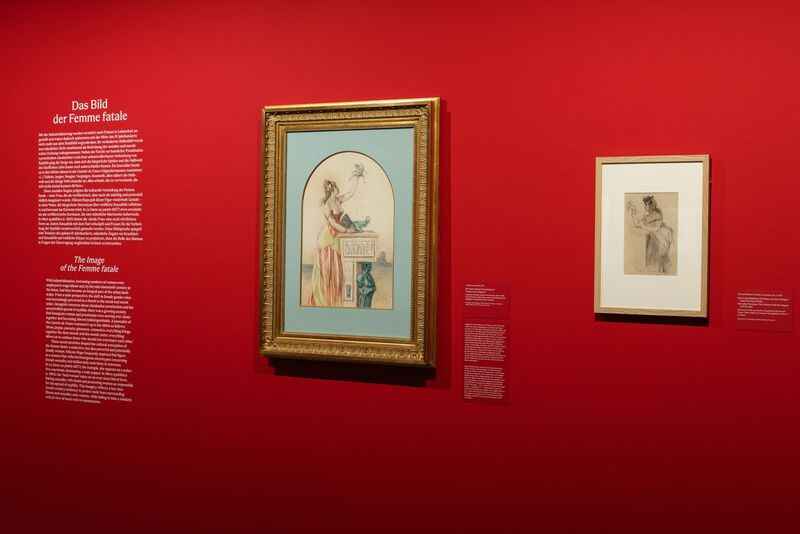
View of the Félicien Rops exhibition in Zurich. Photo copyright © Kunsthaus Zürich.
Back to the Kunsthaus catalog. The writer, cultural critic, freelance curator, emerita from the University of Zurich and Global Distinguished Professor at New York university, Elisabeth Bronfen, explains in her catalog essay that Félicien Rops perpetuated the gender clichés and stereotypes typical of his time.
Juliane Au writes that the second half of the 19th century was a period characterized by ambivalence, marked by the perceived decline of the bourgeoisie, the crisis of social role models, sheer misery, the coexistence of oversaturation and sensual pleasure. At the same time, mysticism and occultism enjoyed great popularity, giving rise to Symbolism, a movement that sought to depict all this through a blend of horror, shudder and beauty. An initial programmatic definition was provided by Jean Moréas’s article ‘Le symbolisme’, published in Le Figaro in 1886.
While celebrated as a book illustrator collaborating with (mostly Symbolist) writers such as Charles Baudelaire, Stéphane Mallarmé, Paul Uzanne, Joséphin Péladan and Jules Barbey d’Aurevillys, Félicien Rops simultaneously developed a private body of work deliberately withdrawn from public view. In drawings and prints, he pushed the gender stereotypes of his era to the extreme and challenged prevailing social norms.
In 1862, Félicien Rops began an artistic collaboration with Auguste Poulet-Oalassis, who published Charles Baudelaire’s works, among others. Two years later, the Belgian would meet the French poet, essayist, translator and art critic in person, when Baudelaire and his publisher and friend Poulet-Malassis came to Namur. A friendship developed between Rops and the French writer. In 1866, the Belgian designed the cover for Baudelaire’s collection of poems, Les Épaves, in which he visually expressed the connection between death and sin (in the form of plants and a snake winding its way through the pelvis of a skeleton), which would become a characteristic feature of his œuvre.
After returning from Paris to Brussels in 1868, Félicien Rops (co-) founded the Société libre des Beaux-Arts, an organization opposed to the official academic art of the salon, together with fifteen other artists. He was appointed its vice-president, Courbet was made an honorary member.
In 1869, Félicien Rops co-founded the Société internationale des Aquafortistes, which was committed to the renewal and dissemination of the art of etching. According to the catalog, one of Rops’s most important views was already made clear here: little could be expected from academic salon art; true modernity lay in the representation of truth.
In the 19th century, Félicien Rops was one of the most prolific, experimental and unconventional printmakers. Yet, his printmaking practice has hardly been scrutinised by scholars. His great technical proficiency made him one the greatest of his time when it comes to printmaking and draughtsmanship.
The art historian Anastasia Belyaeva, specialized in the history and techniques of printmaking, stresses that the artist himself left an overwhelming number of testimonies on his artistic conduct. His letters to fellow artists, printers, publishers and collectors are filled with details on making and circulating prints, precious to any scholar of 19th printmaking. In addition, Félicien Rops left a notebook of detailed technical observations and recipes, mostly related to intaglio printmaking, which he entitled Omniana artistique. The catalog offers a glossary of the artist’s printmaking process.
These are just a few take-aways from a substantial exhibition and its accompanying publication, which raise the question of whether, in opposing bourgeois decency, the Belgian artist exploited the very stereotypes circulated by the civilization he sought to criticize. In short, can art truly transcend boundaries without being recaptured by the discourse within which it operates (Ann Demeester)?
The bilingual (German and English) catalog, edited by Jonas Beyer, Zürcher Kunstgesellschaft/Kunsthaus Zürich, Daan van Heesch: Félicien Rops. Laboratory of Lust, Hirmer, 2026, 208 pages with 93 illustrations, 23 x 27 cm, 9 x 11 inches, paperback with flaps. ISBN: 978-3-7774-4748-3. Accept cookies — we receive a commission; price unchanged — and order the bilingual English/German edition from Amazon.com, Amazon.co.uk, Amazon.fr, Amazon.de.
For a better reading, quotations and partial quotations in this catalogue and exhibition review of Félicien Rops. Laboratory of Lust are not put between quotation marks.
Catalogue and exhibition review of Félicien Rops. Laboratory of Lust added on April 5, 2026 at 16:02 Swiss time. Detail added at 17:27.


