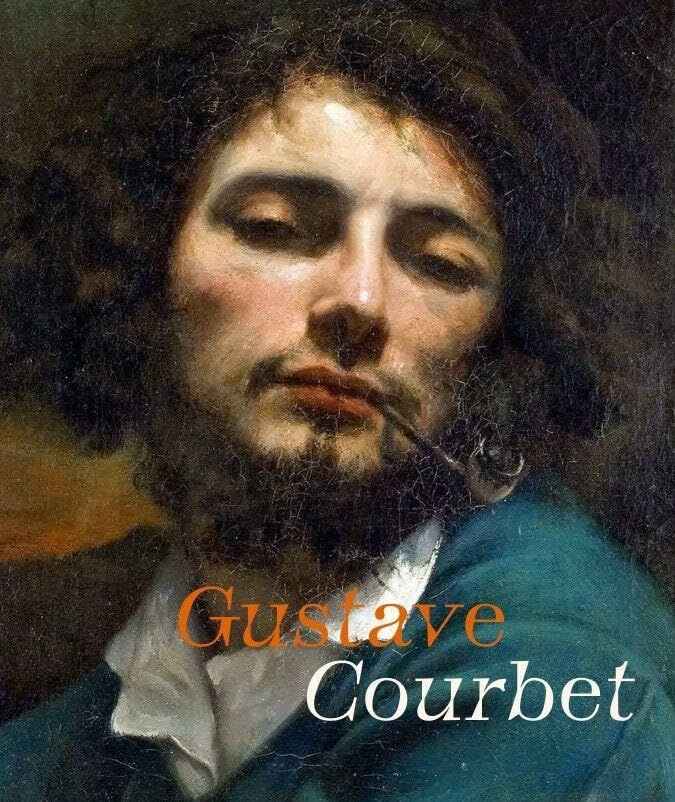
The French painter Gustave Courbet (1819–1877), born into a wealthy farming family in a provincial town, revolutionized the pictorial language of 19th-century art by making the visual reality of his time the subject of his work. He chooses not to pursue the traditional paths to artistic success. He does not seek admission to the Ecole des Beaux-Arts, nor does he strive to train in the studio of an established painter.
According to Lili-Vienne Dubus, instead, Courbet works at the studio of Charles de Steuben (1788–1856) and attends the private art academy of Martin François Suisse (1781–1859) where he is taught to work from live models. He receives educational instructions from Nicolas-Auguste Hesse (1795–1869) who is a mentor to his childhood friend Adolphe Marlet (1815–1888). Courbet feels indebted to none of his teachers, and will later reject the notion of ever having had a mentor. The only artists he accepts as formative role models are the Old Masters whose works he studies and copies with great enthusiasm at the Musée du Luxembourg and the Musée du Louvre.
Beginning in 1667 (!), the Salon was the official art exhibition of the Académie des Beaux-Arts in Paris, which favored historical and mythological subjects. Gustave Courbet abandoned romanticism and idealism, as well as their religious, mythological and historical subjects. Instead, he presented scenes from everyday life, showcased ordinary people – farmers, workers and other townsfolk – in monumental formats and with a presence hitherto reserved to heroic figures.
Already since February 19 and until June 21, 2026, in collaboration with Museum Folkwang in Essen, where it will be shown subsequently, Museum Leopold in Vienna is presenting the outstanding exhibition Gustave Courbet. Realist and Rebel with 130 exhibits – including 90 paintings and 20 graphic works from all the periods of the artist’s oeuvre, as well as a large number of archival materials.
English edition of the exhibition catalog, edited by Hans-Peter Wipplinger and Niklaus Manuel Güdel: Gustave Courbet. Realist and Rebel. Verlag der Buchhandlung Walther und Franz König, Köln, 2026, hardcover, 2026, 345 pages with 270 illustrations, 23,5 x 28 cm. ISBN-13: 978-3753309668. Accept cookies — we receive a commission; price unchanged — and order the English edition from Amazon.com, Amazon.co.uk, Amazon.fr, Amazon.de.
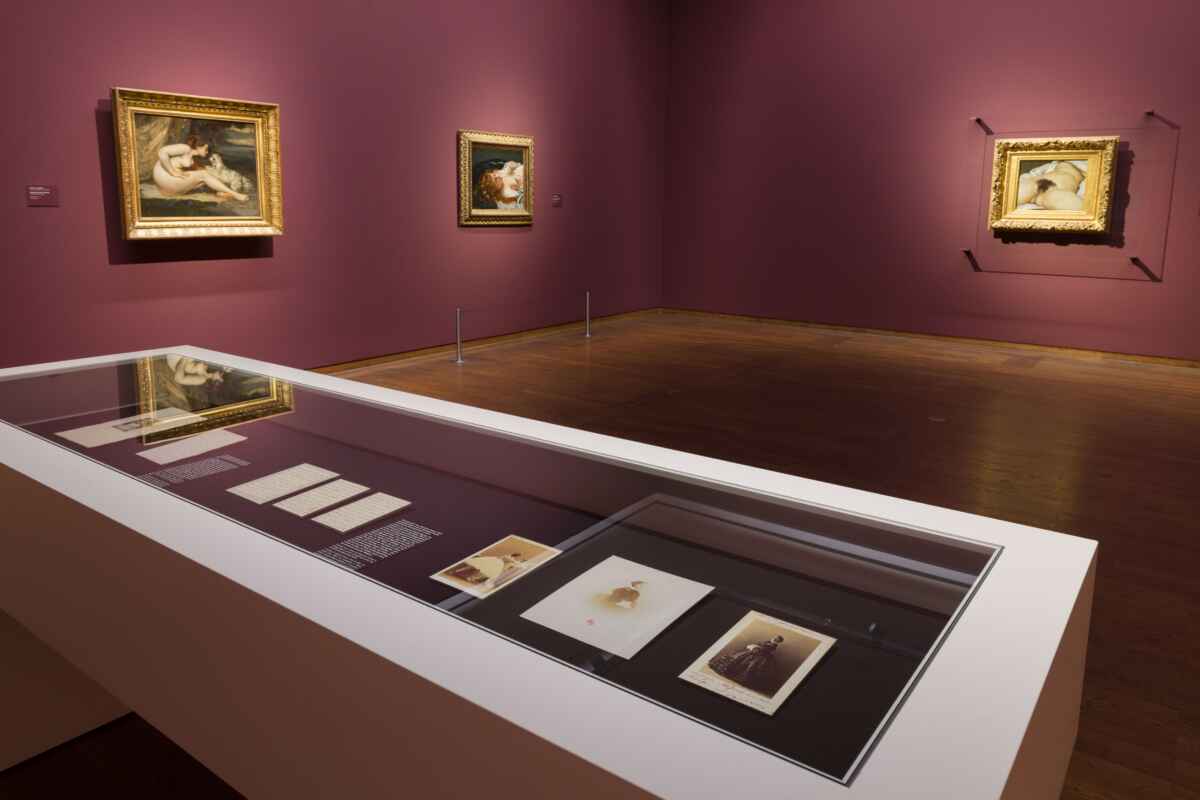
View of the exhibition Gustave Courbet. Realist and Rebel. Photo copyright © Leopold Museum, Vienna. Photograph by Reiner Riedler.
Courbet makes his Salon debut in 1844 with his painting Courbet au chien noir (1842). In the following years, several of his works are refused. In 1847 none of the works submitted by him are accepted by the jury. The artist ascribes this failure to the stylistic changes in his work.
According to the catalog biography by Lili-Vienne Dubus, in Paris, Courbet comes into contact with the local bohemia. Their get-togethers often take place at Brasserie Andler, also known as Andler-Keller, located in immediate proximity to Courbet’s studio on Rue Hautefeuille. The venue is a meeting place for writers and artists.
1848 is not only the year of the republican February Revolution, it marks also the beginning of the birth of Courbet’s realism, which happens over the period from 1848 to 1855.
The curators Hans-Peter Wipplinger and Niklaus Manuel Güdel underline that Gustave Courbet’s realism was not merely about rendering reality but rather a programmatic orientation on the present, a deliberate dispensation with any kind of idealization and a near pastose manner of painting. At the same time, he was a man with a penchant for provocation, not just as an artist, but also as someone with political ambitions. He maintained a friendship with the anarchist Pierre-Joseph Proudhon, who famously – but falsely – claimed that property was theft. In 1865, the painter portrayed his friend in the oil on canvas Proudhon and His Children. Like Courbet, Proudhon opposed the prevailing view of art in his time, and both were staunch opponents of Napoleon III. Courbet stated in 1851: “I am not only a socialist but also a democrat and republican, in a word, a partisan of the revolution and, above all, a realist, that is to say, a sincere friend of the real truth.”
Courbet’s 1849-50 large-format painting A Burial at Ornans (Un enterrement à Ornans), presented at the Salon of 1850/51 , shocked the Parisian art society because of the bypassing of academic traditions. The life-sized depictions of people from the lower strata of society, and the recognition thus accorded to common citizens, farmers, village women and workers, were considered a downright affront. This work made Courbet famous overnight. The gold medal he had received for L’Après-dînée à Ornans at the Salon of 1849 had made no waves.
Courbet saw himself as an autonomous, independent artist. In his work The Meeting aka Bonjour Monsieur Courbet (1854; today part of the collection of the Musée Fabre in Montpellier), which can be admired in Vienna, the painter greets his patron with confidence and on an equal footing, formulating his claim for independence. When 3 of the 14 works he presented for the 1855 World’s Fair in Paris were rejected by the commission, he responded by building his own exhibition pavilion on Avenue Montaigne. He titled the accompanying catalogue: REALISM. Exhibition and sale of 40 paintings and 4 drawings from the oeuvre of M. Gustave Courbet. Courbet defies the supremacy of the official art scene and sets a precedent for free, independent exhibitions. This step marks a turning point in the relationship between artists and institutions, and is considered a milestone in modern exhibition practice.
An early oil-on-canvas painting which epitomizes Courbet’s artistic re-orientation is After Dinner at Ornans, painted in the winter of 1848-1849. The large-format (195 x 257 cm) depiction of an everyday scene from his hometown, featuring his friends and family, won a medal at the Paris Salon of 1849. It was the first time that an unspectacular motif, depicted on the scale of a large-format history painting, won an official distinction. Subsequently, After Dinner at Ornans was acquired by the French government. Today, it is part of the collection of the Palais des Beaux-Arts in Lille.
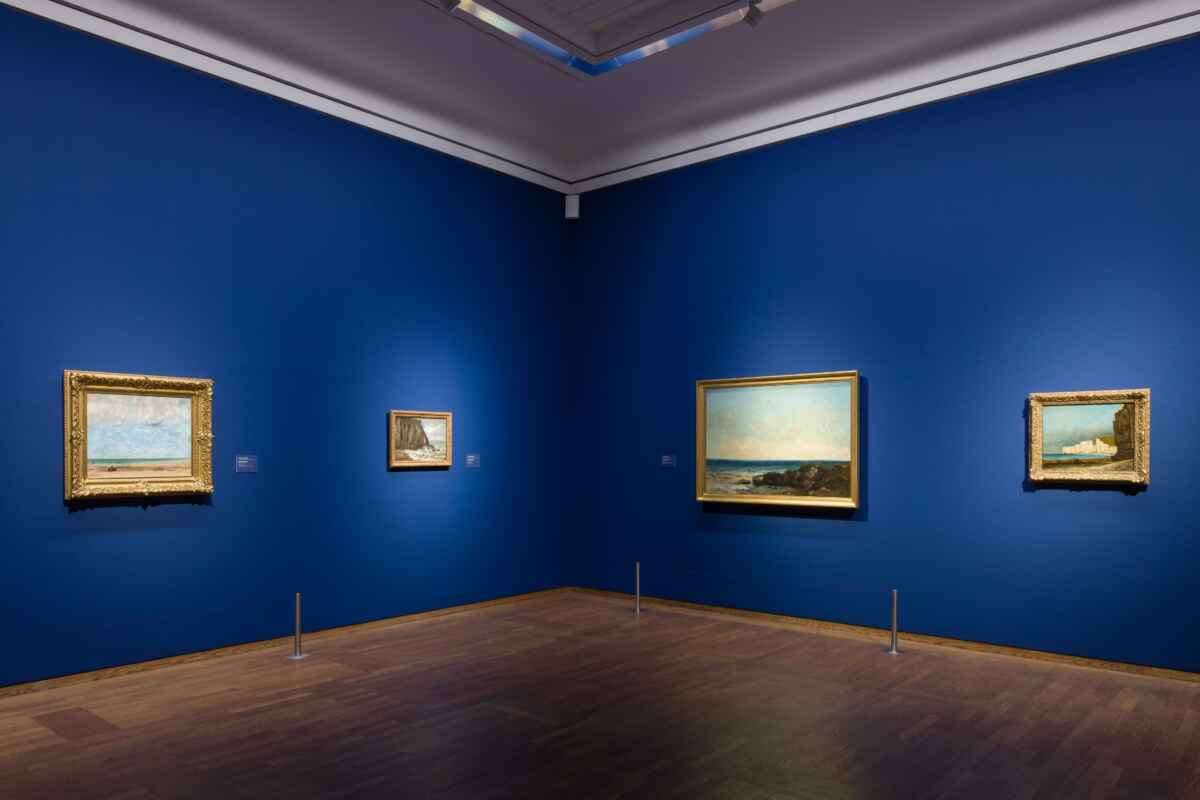
View of the exhibition Gustave Courbet. Realist and Rebel. Photo copyright © Leopold Museum, Vienna. Photograph by Reiner Riedler.
After Dinner at Ornans is not the only major work by Courbet that traveled to Vienna. Even the artist’s most famous painting, The Origin of the World (1866; 46 x 55 cm), normally shown at the musée d’Orsay in Paris, can be admired at the Leopold Museum. According to the Vienna exhibition curators, the close-up view of the vulva in the oil painting on canvas attests to the radical nature of Courbet’s realism. The artist broke with traditional iconography and defied the moral conventions of his time.
In the Vienna catalog, the art scholar Sophie Elaine de Oliveira writes that painted nudes make up only a small part of Gustave Courbet’s oeuvre, but they perfectly express his concept of realist art, materializing the naked truth via brush and paint on the canvas. Metaphorically, the vulva, as the origin of the world, represents the source of life itself. According to Sophie Elaine de Oliveira, this analogy recalls a number of works by Courbet showing natural grottos. The billowing forth of water from the womb of the earth can be understood as a primeval experience, in which the world gives birth to itself. This gives rise to a cosubstantiality of nature and the female body which is typical for Courbet’s nature depictions. The artist even created paintings which combine the subjects of the woman and the source, mostly by rendering a female nude, either completely naked or swathed in white fabric, in the act of bathing on the wooded and moss-covered banks of the source.
Sophie Elaine de Oliveira notes that the first owner of L’Origine du monde was the Egyptian-Ottoman diplomat Khalil-Bey (1831–1879) who had commissioned the work from Courbet. Khalil-Bey had a penchant for erotic art. His collection of hundreds of artworks included The Turkish Bath (1862) by Jean-Auguste-Dominique Ingres (1780–1867) and Courbet’s The Sleep (Le Sommeil, 1866) aka The Two Friends (Les Deux amies) aka Sloth and Voluptuousness (Paresse et Luxure), both commissioned by Khalil-Bey too. The diplomat could not enjoy his collection for long: excessive gambling debts forced him to sell most of his paintings in 1868, though he kept L’Origine du monde. The work was originally reserved for a select circle of viewers. According to the writer Maxime du Camp (1822–1894), the painting hung in Khalil-Bey’s private washing rooms – hidden by a green curtain.
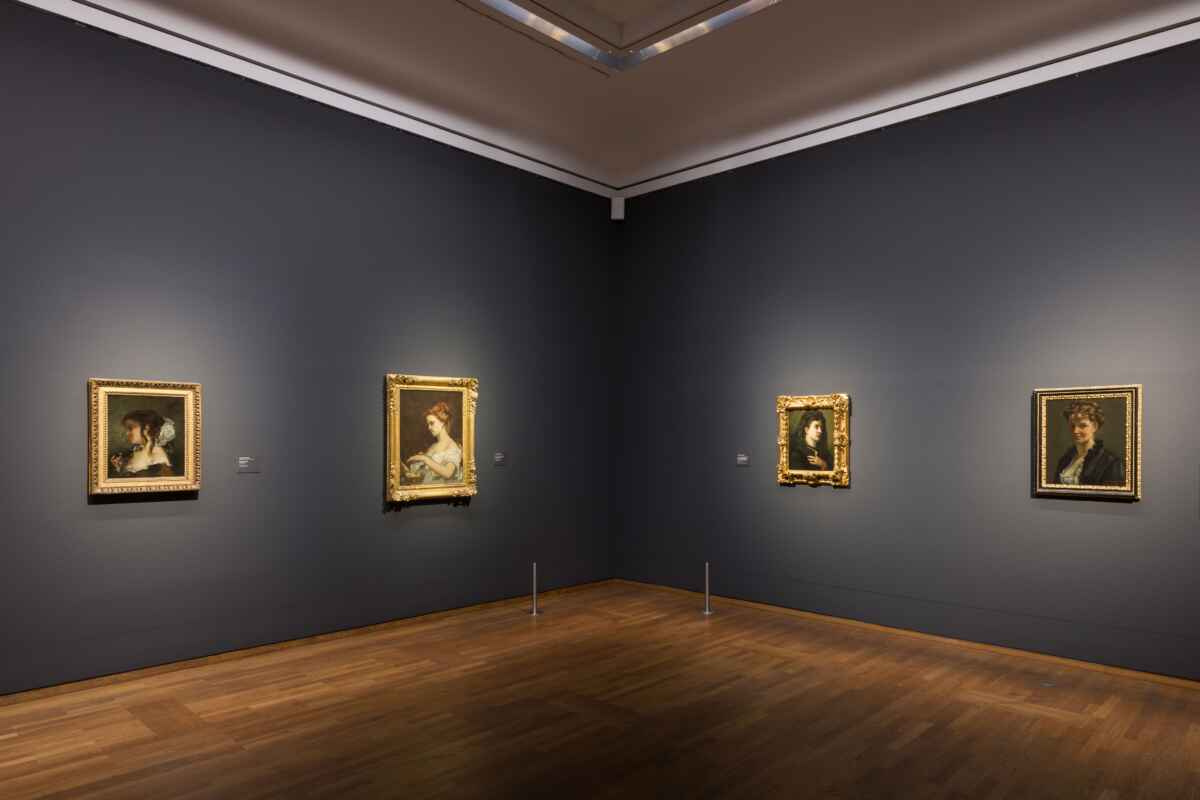
View of the exhibition Gustave Courbet. Realist and Rebel. Photo copyright © Leopold Museum, Vienna. Photograph by Reiner Riedler.
Courbet’s understanding of himself as an independent artist was mirrored by his political activities. After the proclamation of the Third Republic in 1870, and especially during the time of the Paris Commune in 1871, he took on political responsibility in the cultural sector. Leopold Museum Director Hans-Peter Wipplinger writes in his catalog foreword that, following the capitulation of France against Prussia, the republicans appointed Courbet to carry out several, culture-political offices: he was named president of the republican arts commission, and a city councilor and member of the Paris Commune – a short-lived revolutionary government lasting from March 18 to May 28, 1871. After the violent overthrow of the Commune and Courbet’s arrest on June 7, 1871, his trial and a six-month incarceration at Sainte-Pélagie prison, which was cut short by a stay at a clinic in Neuilly due to his ill health, Courbet left Paris for good in 1873.
In June 1873, the French government ordered the confiscation of all his possessions to pay for the cost of rebuilding the Vendôme Column. This forced Courbet into exile, where he died of a liver disease in 1877 at the age of 58.
According to Bruno Mottin, in his last years in Switzerland, in La Tour-de-Peilz, on the shores of Lake Geneva (Lac Léman), Courbet created some resolutely modern works. Pierre Chessex offers a catalog contribution dedicated that period. He writes that, largely overlooked for a long time, Courbet’s period of exile deserves a nuanced assessment based on reliable sources (notably because of an attribution problem for many works).
Since the publication of Lord Byron’s poem The Prisoner of Chillon, written in 1816, touring Chillon Castle on the shore of Lake Geneva had become a fixture for many travelers (not just the ones on the Grand Tour). It is Courbet’s best-known motif from his time in exile. Between 1874 and 1876, the artist painted several renderings of the castle.
According to Lili-Vienne Dubus, in May 1877, Courbet’s definitive verdict is delivered. He is to pay 323,091.68 francs in compensation for the reconstruction of the Vendôme Column – a sum that exceeds his financial means. In order for him to pay part of his debts, a forced sale of his paintings and furniture is held on November 26 at Hôtel Drouot in Paris. Meanwhile, his health deteriorates rapidly: he suffers from edema and cirrhosis of the liver. The artist dies on December 31, 1877 and is laid to rest in La Tour-de-Peilz. Only in 1919, marking the 100th anniversary of his birth, his remains are moved to Ornans.
The Leopold Museum show offers a panorama ranging Gustave Courbet’s early self-portraits and landscapes from his native Ornans (Franche-Comté) to hunting scenes, seascapes, depictions of grottos, to nudes and works created during his imprisonment and during his years in exile. The catalog offers new insights on aspects of his oeuvre which have found little attention so far, including his drawings, graphic works and his years in exile.
This and much more can be discovered in the English edition of the exhibition catalog, edited by Hans-Peter Wipplinger and Niklaus Manuel Güdel: Gustave Courbet. Realist and Rebel. Verlag der Buchhandlung Walther und Franz König, Köln, 2026, hardcover, 345 pages with 270 illustrations, 23,5 x 28 cm. ISBN-13: 978-3753309668. Accept cookies — we receive a commission; price unchanged — and order the English edition from Amazon.com, Amazon.co.uk, Amazon.fr, Amazon.de.
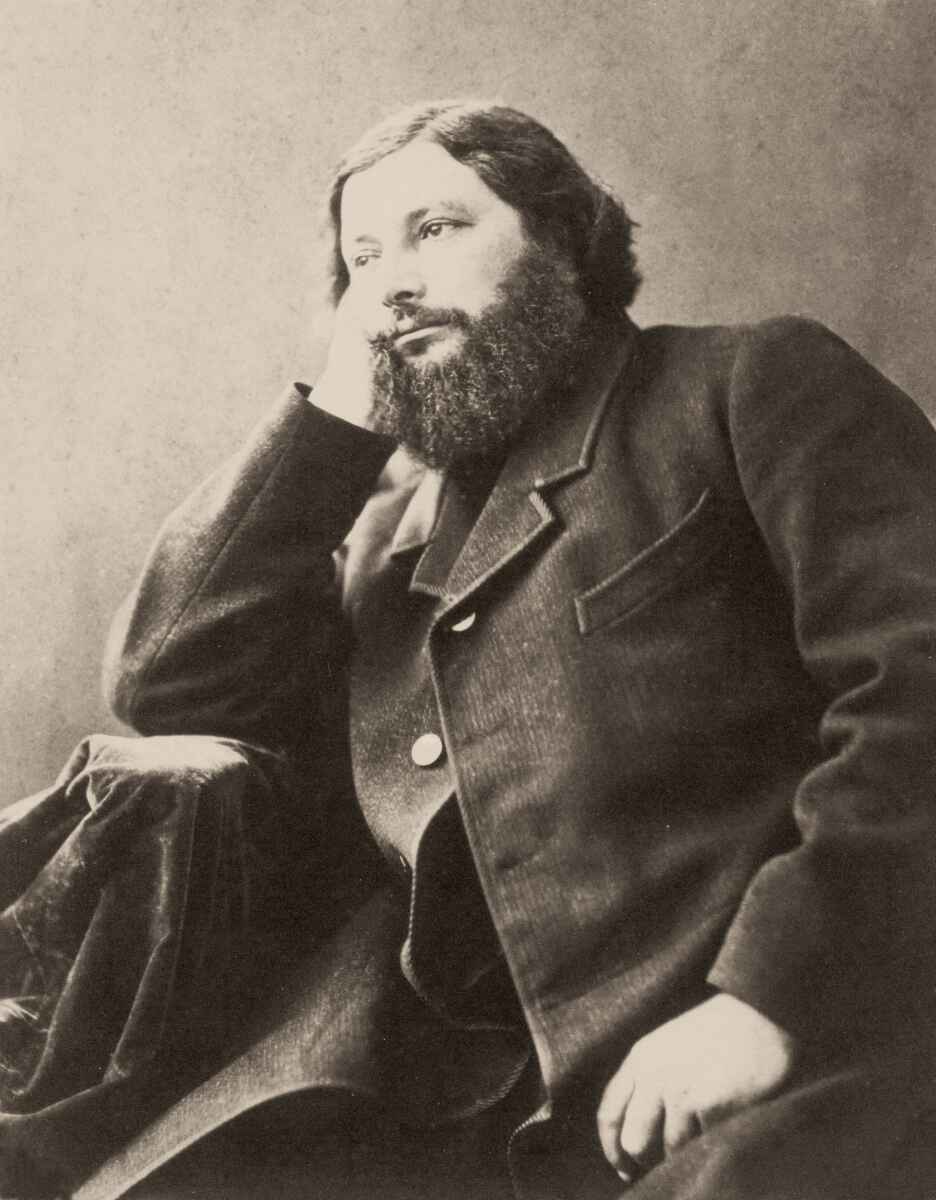
Photograph of Gustave Courbet by Felix Nadar (1820–1910): Portrait of Gustave Courbet, 1866. Archival pigment print, original albumen print from a glass negative, 22.5 × 17.5 cm. Donation by Christian Skrein. Photograph copyright: Leopold Museum, Vienna.
The self-portrait below, Man with a pipe (L’homme à la pipe, 1848–49), normally exhibited at the Musée Fabre in Montpellier, ornates the front cover of the Vienna exhibition catalog. At least four painted versions of this subject exist. There is also a drawing.
For a better reading, quotations and partial quotations in this catalogue and exhibition review of Gustave Courbet. Realist and Rebel are not put between quotation marks.
Catalogue and exhibition review of Gustave Courbet. Realist and Rebel added on April 6, 2026 at 19:15 Austrian time.


