We live in the age of gender studies, in which too many art historians and curators attempt to “discover”, “rediscover”, or “reassess” seemingly forgotten or overlooked female artists. In many cases, these female artists are rightly overshadowed by better male artists—not because men are better artists, but simply because there were so many more male artists than female ones.
Gabriele Münter was a significant artist, yet her work remains—rightly so—in the shadow of that of her teacher and partner for several years, Wassily Kandinsky, even though, during their formative years in Murnau am Staffelsee in Bavaria (she had bought the house there), she in some ways anticipated and influenced his path toward abstraction and Expressionism.
Some great female artists, such as Lee Krasner, had the “misfortune” of working in the shadow of an even greater artist. In Krasner’s case, that man was her husband, the Abstract Expressionist Jackson Pollock; both had a strong influence on each other’s artistic development.
There are a few rare cases in which one wonders why the man in a couple remains better known than the woman, even though she has created work of equal or even higher quality. This is the case with Helen Frankenthaler (1928–2011), who for some years stood in the shadow of the Abstract Expressionist painter, writer and teacher Robert Motherwell (1915–1991), her husband from 1958 to 1971; it was his third and her first marriage.
Today, Helen Frankenthaler’s pioneering works are well appreciated by art collectors. On May 21, 2026 Christie’s will offer her large-scale work The Last Minute in April, acrylic on canvas, 177.8 x 317.5 cm, painted in 1974, for an estimated $2 million to $3 million. On May 15, 2026 Sotheby’s offered her work St. John, acrylic on canvas, 281.3 by 167.3 cm, executed in 1971, for $1.5 million to $2 million, which sold for $2.108500, and Perseus, acrylic on canvas, 120.7 by 241.3 cm, executed in 1983, for an estimated $1.8 million to $2.5 million, which sold for $2.804 million, to mention just a few works and auctions results.
In recent years, several exhibitions in Europe have focused on the work of the still underestimated (by the larger public), although in auctions already highly valued Helen Frankenthaler who had played a pivotal role in the transition from Abstract Expressionism to Color Field painting by inventing the soak-stain technique. On April 4, 1953 Kenneth Noland (1924–2010) and Morris Louis (1912–1962) had seen the 1952 painting Mountains and Sea in Helen Frankenthaler’s studio. The work had inspired them to turn to Color Field painting.
Among the notable Frankenthaler exhibition’s in Europe, let’s mention PITTURA/PANORAMA. Paintings by Helen Frankenthaler 1952–1992, presented by Museo di Palazzo Grimani in Santa Maria Formosa, Venice, Italy, from May 7 until November 17, 2019.
From December 2, 2022 until March 5, 2023 Museum Folkwang in Essen had presented the exhibition Helen Frankenthaler. Malerische Konstellationen, focusing on her works on paper, presenting 84 works.
From September 27, 2024 until January 26, 2025 Palazzo Strozzi in Venice, Italy, had shown the major exhibition Helen Frankenthaler: Painting Without Rules.
From March 16 until September 28, 2025 Museum Reinhard Ernst in Mainz had displayed 32 of her works (including many large-format pieces) in the exhibition Helen Frankenthaler: Move and Make. All exhibits came from Reinhard Ernst’s collection, the world’s most important Frankenthaler collector.
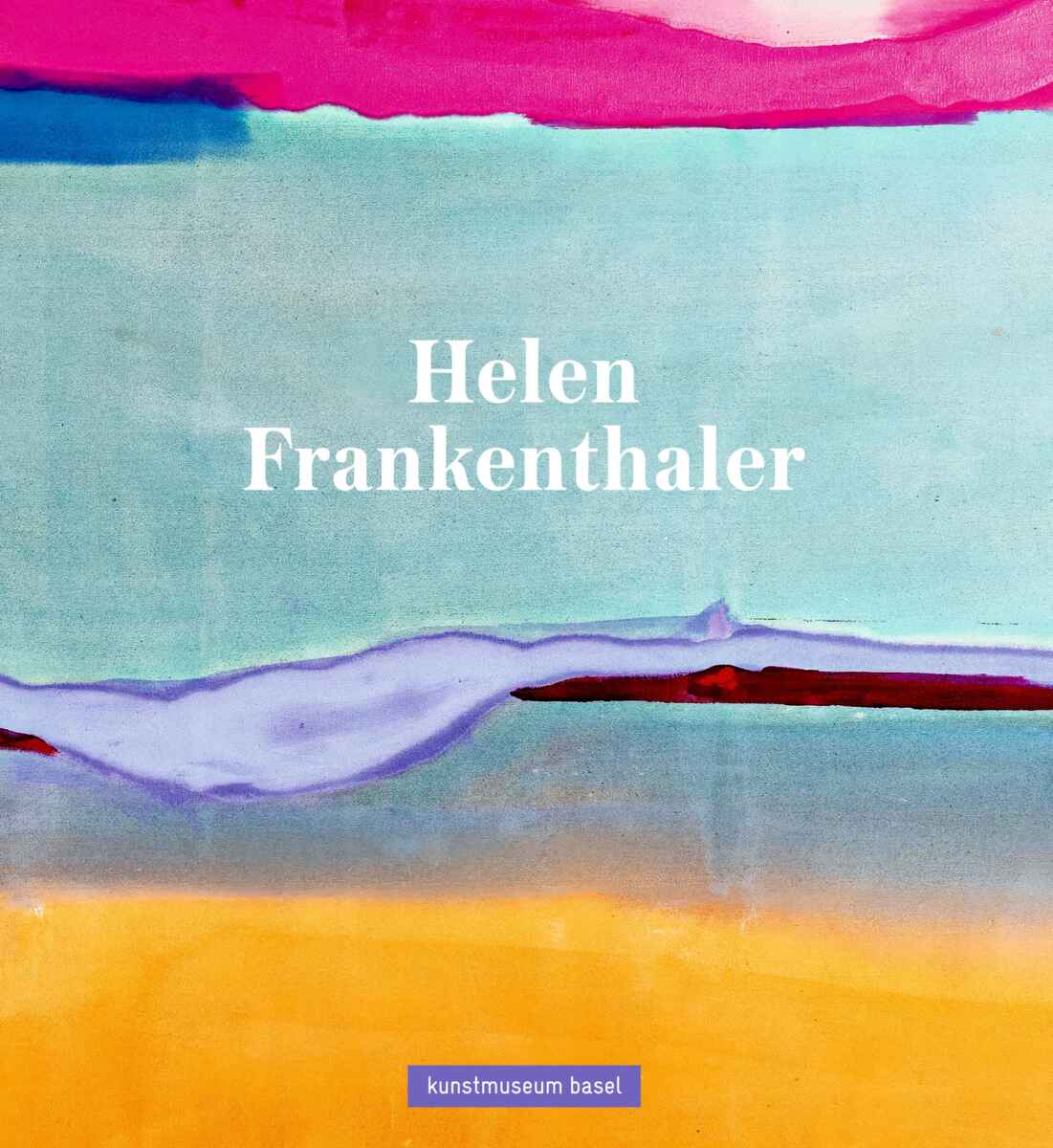
The latest Frankthaler exhibition opened on April 18, 2026, at Kunstmuseum Basel in Switzerland and runs through August 23, 2026. On display are over 50 works from six decades, almost all of which are large-format pieces. The Helen Frankenthaler Foundation provided a generous loan of 37 works by the artist. Notably therefore, the show manages to present examples from the artist’s entire career, with a particular focus on her probing engagement with historic art she admired, including works by Claude Monet, Marie Laurencin, Piet Mondrian and others.
According to the catalog Forew0rd by Kunstmuseum Basel Director Elena Filipovic, Kunstmuseum Basel was the first museum in Europe to acquire works by Abstract Expressionists. In the late 1950s, with the support of the Swiss insurance company Schweizerische National-Versicherungs-Gesellschaft and curator Arnold Rüdlinger (1919–1967), the museum acquired key works by Franz Kline (1910–1962), Barnett Newman (1905–1970), Mark Rothko (1903–1970), and Clyfford Still (1904–1980). However, female Abstract Expressionists remained neglected until recently. Since 2016 through purchases, deposits, and gifts, the museum acquired works by Sari Dienes (1898–1992), Shirley Jaffe (1923–2016), Vivian Springford (1913–2003), and Hedda Sterne (1910– 2011).
There is one screenprint (Air Frame from the portfolio New York Ten) by Frankenthaler that entered the collection of the Kunstmuseum Basel’s Department of Prints and Drawings (Kupferstichkabinett) in 1965. However, this must have happened by chance since it is part of a portfolio containing works by various artists among which she is the only woman. Until recently, the absence of a major work by Helen Frankenthaler (1928–2011) remained painfully glaring. Her work was hardly represented in Swiss public collections, and until recently, remained largely underrepresented in European public collections, despite her central role in redefining the possibilities of postwar painting. An exception is the private initiative of the collector Reinhard Ernst in Wiesbaden, who owns the largest collection of Frankenthaler’s work worldwide.
Elena Filipovic underlines that, in 2024, the Helen Frankenthaler Foundation made an exceptionally generous gesture, gifting Kunstmuseum Basel with Frankenthaler’s monumental, soak-stain, acrylic painting Riverhead (1963; 208.9 x 363.2 cm).
Regarding the biography and details about Helen Frankenthaler’s work, check the Basel catalogue. Here just a few details regarding her early years taken from the catalog entry written by Amanda Kopp-Kempinski.
Helen Frankenthaler is born in New York City on December 12, 1928 into an educated, well-to-do family. The youngest of three daughters of Alfred Frankenthaler (1881–1940), a judge at the New York State Supreme Court, and Martha Lowenstein (1895–1954), a women interested in art with German-Jewish roots, she loses her father when she is only eleven years old. This happens just as the political and social upheavals of World War II begin to reach New York.
As her mother struggles in vain to rescue her Jewish relatives from Germany, Frankenthaler falls into a deep crisis. She finds new stability when she transfers to the Dalton School, a liberal private school in Manhattan, which she attends for one year and graduates from in 1945. There, she takes classes with the Mexican muralist Rufino Tamayo (1899–1991), who recognizes her talent and teaches her the basics of painting. Amanda Kopp-Kempinski stresses in the catalogue’s biography that this encounter will prove pivotal for her artistic development.
From 1946 until 1949, Helen Frankenthaler attends one of the most progressive women‘s college in the United States: Bennington College in Vermont. Paul Feeley (1910–1966) and immerses herself in Cubism. During the winter non-resident terms she teaches art classes for children and writes reviews for the art magazine MKR’s Art Outlook, as well as for the Cambridge Courier.
In the summer of 1948, she embarks on her first trip to Europe with her friend, the German-born future actress, theater director and journalist Gaby Rodgers (b. 1928), the daughter of Jewish art dealer Saemy Rosenberg, the niece of art historian Jakob Rosenberg and the great-niece of the philosopher Edmund Husserl. They visit London, Amsterdam, Brussels, Switzerland, and Paris, and go to museums where she encounters works from the 15th to 17th century. The trip is, however, also troubling, as the scars of the recent world war are still clearly visible in Europe.
By 1949, Helen Frankenthaler rents her first studio on East 21st Street in New York, which she shares with her fellow student from Bennington, the author Sonya Rudikoff (1927–1997). She graduates from college in July of that year and attends a short course in art history taught by Meyer Schapiro (1904–1996) at Columbia University.
In the spring of 1950, Helen Frankenthaler organizes a group exhibition with graduates of Bennington College at the Jacques Seligmann Gallery in New York, where she meets the influential art critic Clement Greenberg (1909–1994). Although he does not like her work, the two become a couple and would remain together until 1955. Through Clement Greenberg, she gains direct access to the key players on the New York art scene. As a detail, let’s mention that Helen Frankenthaler was with Lee Krasner in Paris when Krasner’s husband, Jackson Poll0ck, died in a single-car accident in his Oldsmobile convertible while driving under the influence of alcohol.
In July 1950, Helen Frankenthaler attends the Hans Hofmann School of Fine Arts in Provincetown, Massachusetts. In November, she sees Jackson Pollock’s works for the first time in an exhibition at the Betty Parsons Gallery in New York. Pollock’s techniques of thinning paint and painting on canvases lying flat on the floor makes a deep impression on her and becomes a crucial impetus for her own development as a painter.
According to Anita Haldemann, it is at the Fifteen Unknowns exhibition at the Kootz Gallery in December 1950 that she was first recognized as a serious painter, she was hailed as one of the most talented painters of the younger generation. According to the Basel curator, although her 1950 work Beach lacks the opaque forms of Cubism, a spatial effect is created by the lines, which no longer serve to outline anything. In places, the paint is mixed with sand, plaster, and coffee grounds, creating a paste-like surface on the canvas that could also be scored. In this way, inspired by Jean Dubuffet (1901–1985), Helen Frankenthaler emphasized the materiality of the painting surface; Dubuffet had been exhibited in 1950 in New York at the Pierre Matisse Gallery and, at the end of that year, with Willem de Kooning, at the Sidney Janis Gallery. The markings in Beach, which only vaguely evoke plants and figures, are reminiscent of Arshile Gorky, as well as of Jackson Pollock’s painting from the mid-1940s.
Amanda Kopp-Kempinski mentions that Helen Frankenthaler participates in the groundbreaking group exhibition 9th St.: Exhibition of Paintings and Sculpture in New York City in 1951, organized by the artists of the avant-garde movements themselves. This same year, her work is also represented in the group exhibition The New Generation at the Tibor de Nagy Gallery, which also presents her first solo exhibition. Works on display include The Sightseers and August Weather, both exhibited in Basel. The show is generally well received. By 1958, the gallery will have held six solo exhibitions of her work.
In 1952, she participates in several group exhibitions, including the Stable Gallery’s Annual Exhibition of Painting and Sculpture. In the summer, Frankenthaler travels with Greenberg to Nova Scotia in Canada. There she paints and draws outdoors. In autumn, she begins sharing a studio with the German-born artist Friedel Dzubas (1915–1994) on West 23rd Street.
In the 2026 Kunstmuseum Basel catalog, the exhibtion curator and catalog editor Anita Haldemann writes that Helen Frankenthaler’s October 26, 1952 Sunday work Mountains and Sea (oil and charcoal on canvas, 220 x 298.8 cm) marked a major breakthrough: the invention of the soak-stain technique, at the tender age of 23! She breaks away from influential role models such as Jackson Pollock (1912-1956), Willem de Kooning (1904-1997), Arshile Gorky (1904–1948), Adolph Gottlieb (1903–1974) and Joan Miró (1893–1983).
Anita Haldemann underlines that Pollock let the paint flow, drip, and splash out of cans, a process he controlled with sticks or the movement of his wrist, but without touching the canvas. Frankenthaler, however, was not interested in painting like Pollock. Rather, she understood the implications of his technique and used this entirely liberated way of thinking as a springboard. The spatial expansion, the movement of the body, the iconoclasm and function of the lines, as well as the interchangeability of figure and ground were the features she shared with Pollock.
Anita Haldemann stresses that Helen Frankenthaler used a completely new technique: she abandoned the easel and took up the entire space, replacing the small gestures of the brush with the deployment of her whole body. Getting on her knees, she used coffee cans and brushes to spread oil paint diluted with turpentine or kerosene onto the unprimed canvas, which she had laid flat on the floor and drawn lines with charcoal. The larger the works she now created with this method became, the more intense was the physical effort they required. Frankenthaler stood, knelt, and moved around the edges of the canvas and over it, working on it from all four sides.
According to John Elderfield’s revised, expanded monograph Frankenthaler, the originality of Mountains and Sea was at its first exhibition in 1953 not immediately recognized, probably partly not even by the artist herself. It was not until 1960, when Clement Greenberg wrote about its influence on two of his then favorite artists (Kenneth Noland and Morris Louis), that the wider recognition followed.
Mountains and Sea is exhibited at the National Gallery of Art in Washington, DC. It is an extended loan to the museum by the Helen Frankenthaler Foundation. Unfortunately, this key work could not travel to Basel. However, works made a few months later, in 1953, are on display at the current, major exhibition.
According to Anita Haldemann, the oil painting Shatter (1953), exhibited in Basel, demonstrates the way Helen Frankenthaler controlled the flow and distribution of paint on the canvas, confidently allowing pigments to condense or empty spaces to remain between them. While cool colors are perceived as receding into depth or distance and warm colors come more to the fore, the restrained tones nevertheless produce the effect of unity with the tone of the untreated canvas.
Still according to Anita Haldemann, with the work Open Wall (1953), also on display in Basel, the artist pushed her approach even further: the format is larger, the forms strain against and beyond the edge of the picture, and she again used a panoramic format. The line as a drawn trace or brushstroke is no longer visible in Open Wall. Still, drawing remains important in terms of spatial effect. Carol Armstrong has elaborated on the development of the complex relationship between line/drawing and color in Frankenthaler’s painting. On this account, the artist practically celebrated ambiguity. Frankenthaler was not interested in color alone, but in drawing with color and creating spatial effects, harkening back repeatedly to her Cubist influences. The line as an outline, or a fine black line, had disappeared in her work when having absorbed Cubism, but its necessary function and purpose remained. Frankenthaler produced spatial illusions, staging light and color, only to immediately emphasize the flatness and materiality of her paintings. Helen Frankenthaler herself commented on this phenomenon: “Scale and the play of space and light are largely what it’s all about.”
The exhibition curator and catalog editor Anita Haldemann quotes the young Helen Frankenthaler (from May 1950), who developed an unmistakingly distinctive voice amidst an art world dominated by men: “[t]he only rule is that there are no rules. Anything is possible. . . . It’s all about risks, deliberate risks.”
As mentioned above, these are just a few insights into the artist’s early career. One last piece of information gathered from an eyewitness, Lise Motherwell, Director and Chair of the Helen Frankenthaler Foundation. She told me after the press presentation of the Helen Frankenthaler exhibition at Kunstmuseum Basel regarding her father Robert Motherwell and her stepmother Helen Frankenthaler (who had no children of her own): “She was the light; he was the darkness.” In addition, during the press presentation, Lise Motherwell had described her stepmother “in one word: fun!”
Edited by Anita Haldemann: Helen Frankenthaler. English edition, Kunstmuseum Basel, Deutscher Kunstverlag, May 2026, 96 pages with 140 illustrations, 25.5 × 28 cm, paperback. ISBN: 978-3-422-80386-2. Accept cookies — we receive a commission; price unchanged — and order the English edition from Amazon.com, Amazon.co.uk, Amazon.fr, Amazon.de. German edition/Deutsche Ausgabe from Amazon.de.
Further reading offers John Elderfield’s revised, expanded, voluminous monograph Frankenthaler (Gagosian, 2024, 472 pages with over 300 color reproductions; originally published in 1989).
For a better reading, quotations and partial quotations in this catalogue and exhibition review of Helen Frankenthaler are not put between quotation marks.
Catalogue and exhibition review added on May 17, 2026 at 20:21 Swiss time.


