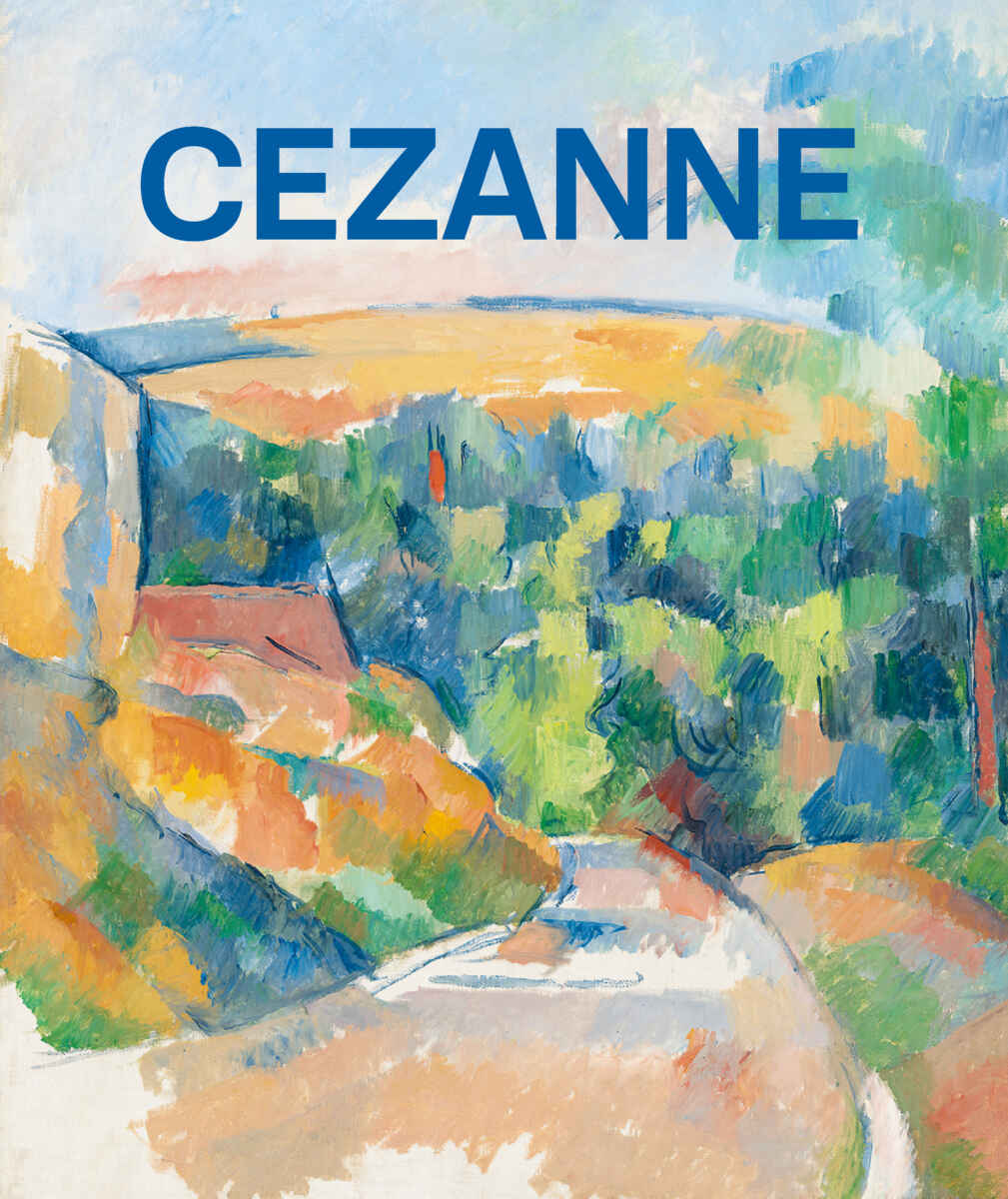
The œuvre of Paul Cezanne (1839-1906) builds a bridge between Impressionism (German article) and abstraction. The French painter is one of the pioneers of modern art. Pablo Picasso went as far as to call him “the father of us all” (“notre père à nous tous”), as the curator Ulf Küster and the museum director Sam Keller note in the foreword to the 2026 Fondation Beyeler Cezanne exhibition. They could also have added that Picasso once said that what Cézanne did with reality “was much more progressive than the steam engine” (Picasso affirmait que ce que Cezanne avait fait avec la réalité “constituait un progrès beaucoup plus important que la machine à vapeur”).
From January 25 until May 25, 2026 the outstanding Fondation Beyeler in Riehen near Basel (Switzerland), created by one of the co-founders of the world’s leading art fair Art Basel, Ernst Beyeler (1921-2010), presents 59 oil paintings and 21 watercolors by the French artist in its new blockbuster exhibition Cezanne.
Edited by Ulf Küster for Fondation Beyeler: Cezanne. Hardcover, 240mm x 280mm, Hatje Cantz, 2026, 200 richly illustrated pages with texts by Louise Bannwarth, Gottfried Boehm, Ulf Küster, Fabienne Ruppen; drawings by Sarah Weishaupt. ISBN: 978-3-7757-6230-4. Accept cookies — we receive a commission; price unchanged — and order the English edition of this exhibition catalogue from Amazon.com, Amazon.co.uk, Amazon.fr, Amazon.de.
Sam Keller and Ulf Küster explain in their catalogue forward that Cezanne’s stated goal was no longer to depict nature but to analyze the process of painting motifs from nature and make this process visible. He termed this method “realization” (réalisation). It was based on the conversion of colored visual impressions into patches of paint (taches), which he used to construct his paintings. He created a “harmony parallel to nature,” an image that stands on its own, even though a motif remains clearly discernible. From the taches, which are, in a sense, independent of the reality perceived by the senses, it is only a small step to the total abstraction of the natural model and to nonrepresentational painting, according to the foreword.
The exhibition showcases Cezanne’s groundbreaking late work from the mid-1880s onwards, focusing on key themes such as still lifes, portraits, landscapes and scenes of bathers. Half of the paintings on display are loans from private collections, many of which are rarely seen in public. Fondation Beyeler alone holds five oil paintings and two watercolors by Paul Cezanne in its collection. In addition, nine museums have lent major works to the show.
Among the highlights at Fondation Beyeler are nine depictions of the Montagne Sainte-Victoire as well as the joint presentation of two of Cezanne’s rare depictions of card players, one from the Courtauld Gallery in London, the other from the Musée d’Orsay in Paris
Cezanne also features over 30 landscape paintings depicting the Provence region in the south of France, 14 of the artist’s fruit still lifes, eight masterful portraits and self-portraits and, with Millstone in the Park of the Château Noir (Millstone) from around 1892–1894 (La pierre à moudre au parc du Château Noir (La meule)), a major work from the Philadelphia Museum of Art, presented in Europe for the first time; if you should be from Philadelphia or travel there, have a look at the fabulous Barnes Collection (additional, more recent article in German), which host 69 (!) works by Cezanne. Another first at Fondation Beyeler is the juxtaposition of two watercolour versions of The Boy in the Red Vest. In addition, the Fondation Beyeler presents several works that have not been shown publicly for decades, among them the Portrait de Paul Cezanne (Portrait of Paul Cezanne) created around 1895, today part of a private collection.
In addition, the show offers several portraits of the gardener Vallier. Unfortunately, the oil paintings are separated from the one watercolor, which is shown in a separate room with (deliberately) unfinished works.
Paul Cezanne rendered the structures of his pictures visible, inviting viewers to engage with and participate in the painting process. This is in particular true for the numerous intentionally unfinished paintings he created; Fondation Beyeler presents an important selection of those works. Their open-endedness allows viewers to engage mentally, to continue and complete them in their imagination.
Born in Aix-en-Provence in 1839, Paul Cezanne freed himself of the influence of Impressionism (German Impressionism article) in the mid-1880s and found the style that would make him a key figure of modern art. He took a radical new departure by releasing painting from traditional conventions such as the central-perspective. The landscapes of his native Provence provided him with a field of experimentation in which to develop his vision of a new form of painting offering a new visual language.
With his views of the Montagne Sainte-Victoire and forests bathed in southern light, Paul Cezanne influenced not only the history of art but also the way in which the region is perceived to this day. His pictures turned the Provence into a place of longing, where nature, calm and timeless beauty merge. By translating the landscape into colors, Cezanne gave it an iconic presence that resonates far beyond painting. The core of his art explores the question how to paint the world as one really experiences it.
From the 1880s to his death, Paul Cezanne painted the Montagne Sainte-Victoire about 30 times in oil. In addition, he produced numerous watercolors. The exhibition at the Fondation Beyeler brings together seven oil paintings and two watercolors. The Montagne Sainte-Victoire motif helped Cezanne test his technique of constructing images on canvas. He did not paint objects as he knew them but rather what he saw directly before him: sensory impressions of color (sensations colorantes), which he transposed onto canvas as patches of paint (taches colorées). He thus explored the way form can be created by mere color. His many versions were less the expression of an unrelentingly inquiring mind than a systematic attempt to approach this way of seeing. He sought to reconcile the mountain’s enduring force and the fleeting impressions of the moment.
In 1904, Paul Cezanne noted in a letter to his artist friend Emile Bernard (1868-1941): “All forms in nature can be traced back to spheres, cones and cylinders. You have to start with these simple basic elements, then you can do anything you want. You don’t have to reproduce nature, but rather present it. How? Through designed, colored equivalents.” No wonder he influenced artist’s such as Pablo Picasso and Georges Braque.
Another key theme featured in the Fondation Beyeler exhibition are figures of bathers. Paul Cezanne repeatedly explored the relation between the human body and nature. Rather than depicting idealized figures, he fused bodies and landscapes to such an extent that the bathers take on the rhythm of the trees and the curve of the river bank, or seem to grow from the ground like plants. This quiet merging lends his bathing scenes their distinctive tension: the figures are both there and about to fade into their surroundings. His bathers combine the classical tradition of the nude with a modern understanding of form and space.
Cezanne’s still lifes manifest his tireless endeavour to transfer the visible world into a stable, almost timeless order. His seemingly straightforward arrangements of apples, pears, oranges, jugs, pitchers, bread and carefully draped cloths operate as a stage on which to explore form, color and balance. By condensing pieces of fruit into compact bodies of color, draping fabric into animated landscapes and exploring the subtle play of light and shadow on the smooth surfaces of various vessels, he transformed common objects into constitutive elements of a new pictorial architecture. Each object is given weight, volume and spatial effect. Visitors can experience Cezanne’s quest for the inner order of things.
Paul Cezanne was aware that we all must die (memento mori). His skull still lifes reflect this existential question. In his works, the skull takes on a dense, sculptural presence, whose weight, shadow and outlines are granted the same attention as all the other objects of Cezanne’s still lifes. The object’s material reality merges with a reflection on time, mortality and fleetingness.
On the cartoon pages at the end of the catalogue with a text by Ulf Küster and illustrations by Sarah Weishaupt, you can find a reference to friendship of Paul Cezanne and the writer Emile Zola, which goes back to their youth in Aix-en-Provence. It was Zola who encouraged Cezanne to abandon his law studies and devote himself to painting, introduced him to artistic circles in Paris and, in 1866, dedicated his first review of the Salon to his childhood friend. Their relation soured over Zola’s novel L’Œuvre (The Masterpiece) in 1866.Claude Lantier is a revolutionary artist whose work is misunderstood by an art-going public hidebound by traditional subjects, techniques and representations. Cezanne recognized himself in the book’s tragically failing artist Claude Lantier, who ultimately hanged himself from his easel. Many of the characteristics ascribed to Claude Lantier are a composite taken from the lives of several impressionist painters including Claude Monet, Edouard Manet, as well as Paul Cezanne.
On April 15, 2026 from 18:30 until 20:00, during a public presentation at Fondation Beyeler, Stéphane Guégan and Robert Kopp will examine the complexe relationship between the painter and the writer, based on just recently fully published correspondence between the two artists (1858—1887). Attendence to the event is included in the museum admission price.
Cezanne was an outsider. He was neither admitted to the Ecole des Beaux-Arts nor did he succeed, except in 1882, in showing his pictures at the Salon, the official annual art exhibition. Cezanne’s first solo exhibition only took place in 1895 at Ambroise Vollard’s gallery in Paris. His works provoked strong reactions from the public and most art critics, but also began to attract the interest of collectors such as Auguste Pellerin. Cezanne really rose to prominence around 1900, especially among painters of the younger generation, such as Emile Bernard or Maurice Denis.
Cezanne influenced Cubist painters such as Pablo Picasso and Georges Braque. If you have a closer look at Picasso’s Les Demoiselles d‘Avignon, you will find surprising parallels with Cezanne’s Les Baigneuses from 1899. It was the Spaniard’s first encounter with the art of the French outsider. He saw the painting during a visit to the fellow artist Henri Matisse. The parallels: the cloth hung over the branch like a tent in Cezanne’s painting reappears as a draped background in Les Demoisellesd d’Avignon. The poses of two bathers can be described as almost identical to the poses of the second standing figure from the left and the figure crouching at the bottom right in Picasso’s painting (Anne Ganteführer-Trier: Kubismus, TASCHEN, 2007).
In addition to general remarks about the innovative painter by the curator Ulf Küster, the Fondation Beyeler exhibition catalogue features short texts about Cezanne seeing differently (Gottfried Boehm), Cezanne’s portraits of the Gardener Vallier (Louise Bannwarth), about Cezanne’s special way of painting and the limited information by the Frenchman himself about his art (Fabienne Ruppen), and the above mentioned illustrated Cezanne biography by Ulf Küster and Sarah Weishaupt.
These are just a few takeaways from the exhibition catalogue edited by Ulf Küster for Fondation Beyeler: Cezanne. Hardcover, 240mm x 280mm, Hatje Cantz, 2026, 200 richly illustrated pages with texts by Louise Bannwarth, Gottfried Boehm, Ulf Küster, Fabienne Ruppen; drawings by Sarah Weishaupt. ISBN: 978-3-7757-6230-4. Accept cookies — we receive a commission; price unchanged — and order the English edition of this exhibition catalogue from Amazon.com, Amazon.co.uk, Amazon.fr, Amazon.de.
P.S. In the Provence region, the name Cezanne was written without an accent aigu (é). Paul Cezanne himself always signed his works and letters without an accent aigu.
For a better reading, quotations and partial quotations in this catalogue and exhibition review of Cezanne are not put between quotation marks.
Catalogue and exhibition review added on February 18, 2026 at 14:03 Swiss time.


