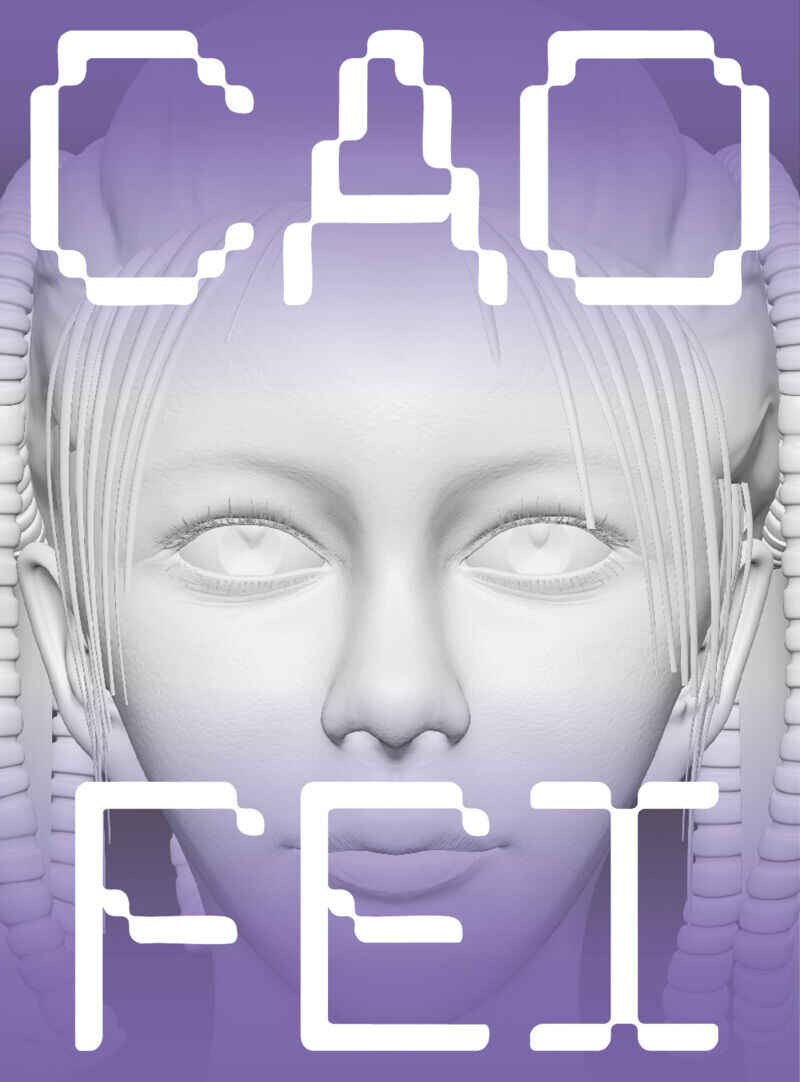
In 1978, Cao Fei was born in Guangzhou — aka the factory of the world — , where she studied art. Today, she lives and works in Beijing, China’s capital. She is considered one of the leading artists of her generation. Her work across multiple media — including video, photography, sculpture, digital media and installation — examines how social and technological change, economic growth and globalization shape human life, society, social relationships and collective perceptions in China since Deng Xiaoping introduced dramatic reform policies in 1978. Cao Fei notably focuses on the fundamental changes in the Pearl River Delta area.
Already since May 30 and only until October 11, 2026 Kunstmuseum Basel | Gegenwart — a separate building a few hundred meters away from the main museum complex — presents Cao Fei’s largest survey exhibition in Europe to date and her first solo show in Switzerland, entitled Cao Fei: Testimonies to the Near Future.
The future is part of our present. Traces of what has not yet been and glimpses of what will soon have passed are presented in Cao Fei: Testimonies to the Near Future, blurring the boundary between the physical and virtual realms.
Curated by Stephanie Seidel, Philipp Selzer, Alice Wilke, the exhibition transforms the four floors of Kunstmuseum Basel | Gegenwart into a total work of art that takes the form of a city blending immersive installations and video universes from her oeuvre of the past thirty years, bringing together a rich an layered visual universe, bringing together street life, parks, factories, offices, a cinema, a playing field as well as an archive on the top floor.
Cao Fei’s works address questions of identity, embodiment and recollection. Among the notable works presented in Basel are: Whose Utopia (2006), a film about the dreams and passions of workers in an Osram light bulb factory in Foshan; RMB City (2007–2011) — the fast-changing virtual city Cao Fei built on the once popular online platform Second Life. RMB refers to the Chinese currency Renminbi. Therefore, the title can be translated as city of money; Asia One (2018) is a film about two people and a robot powered by AI working together in the first fully automated distribution center in Kunshan (near Shanghai). It is a film about solitude, monotony, surveillance, mechanical precision. But, at one point, a group of workers suddenly appears in costume, dancing to disco music beneath a banner reading “Humans and Machines, Hand in Hand”. The colors and choreography evoke the aesthetic of model operas of Mao’s brutal, bloody Cultural Revolution (1966-76); Nova (2019) is a film about the future and technology, bringing together science fiction and elements of a historical film. In the fictional city of Nova, an ambitious computer scientist works on a secret mission. Together with an international research team, including a Soviet scientist, he develops a novel computer platform designed to enable travel through time and space, as well as the transformation of human existence from physical into digital matter. The attempt fails, and the scientist’s own son is lost in cyberspace, suspended in a state of data body and physical form, between dream and reality, past and future. Cao Fei draws on the aesthetics of the post 1949 revolutionary decades, interweaving them with futuristic visions. The scientific team of Nova and its figure of the cosmonaut reappear in Cao Fei’s 2022 installation Matryoshka Verse, linking these works into an ongoing cinematic universe in which history, speculation and memory intertwine; another notable work is Oz (2022) — an avatar of Cao Fei, for whom their is no opposition between the physical and the digital world. Identity is no longer permanent, but unstable, manifold and context dependent. Our digital self-representation allows us to create, reproduce, modify and multiply our “personalities”; Hip Hop is a multi-part series (2003–), which welcomes visitors on the Basel museum’s ground floor. After passing by skate ramps and graffiti, loud hip-hop music played by videos shot in the streets of New York City, Guangzhou, Shanghai, Fukuoka and Sydney dominate. The Hip-Hop videos highlight the hybrid nature of contemporary global culture. They capture people dancing to hip-hop music amd Cantopop in public places, with a particular focus on members of the Chinese diaspora and their rebellious spirit. The lo-fi aesthetic and rhythmic of the videos echo the concept of musical sampling.
After the press presentation in May, standing in front of the Cosplayers (2004) video, I thought about its meaning: buffalos going into the water, a man sitting on an artificial “zebra”, letting balloons fly, plastic cows, cosplayers in between construction sites and open spaces. I thought about the contrasts between meadows and tall buildings, and about how quickly things are changing in China. At that moment, Cao Fei walked by — and I asked her about the video’s significance. She pointed out an additional meaning to me: the contrast between the aspirations of the young people in the video and those of their parents. In a free, helpful booklet available at the Cao Fei: Testimonies to the Near Future exhibition, I could read that Cosplayers can be understood as a tribute to self-determination by the young Chinese cosplayers. At the same time, the work reflects on the cost of rapid urban development. The meadow where cosplayers in the video released black balloons into the air is now part of Zhujiang New Town — a vast business district with skyscrapers and luxury apartments.
This and much more can be discovered at Kunstmuseum Basel | Gegenwart. But only until Sunday, October 11, 2026. Last days!
The accompanying publication by Kunstmuseum Basel and Stedelijk Museum Amsterdam, Buchhandlung Walther König, 2026, 108 pages: Cao Fei: Testimonies to the Near Future. Accept cookies — we receive a commission; price unchanged — and order the catalog with texts in English/German/Chinese from Amazon.com, Amazon.fr, Amazon.de.
This artist book is co-produced by the Kunstmuseum Basel, the Stedelijk Museum Amsterdam, and the Hartwig Museum, Amsterdam. It elaborates on the narrative impulses within Cao Fei’s works. A newly commissioned fictional text by Chinese science fiction author Regina Kanyu Wang features Cao Fei’s avatars China Tracy and Oz as protagonists, while Chinese artist Yufei interprets Cao Fei’s worlds through a series of illustrations inspired by traditional Chinese paintings. Along with stills from Cao Fei’s video works, these contributions have been embedded into a compelling and vibrant design by Studio Moono, Basel.
For a better reading, quotations and partial quotations in this catalog/catalogue and exhibition review are not put between quotation marks.
Article added on October 8, 2026 at 19:35 Swiss time.


