On December 19, the European Union summit regarding aid for Ukraine ended with mixed result. On the positive side, the EU agreed to offer Ukraine a €90 billion loan package over the coming two years to keep the country afloat. On the negative side, Orban‘s Hungary, Fico‘s Slovakia and Babis‘s Czech Republic refuse to contribute financially to help Ukraine fight off Putin’s Russia. In addition, the 27 EU countries failed to agree on using Russian state assets frozen in Western Europe.
The €90 billion interest-free loan for Ukraine is not backed by frozen Russian assets, but by the European Union budget. The Flemish nationalist and Prime Minister of Belgium Bart De Wever of the New Flemish Alliance (N-VA), a political party advocating for the transformation of Belgium into a confederal state, strongly opposed the idea to seize the Russian assets.
From the outset, Bart De Wever had opposed the plans largely pushed by the German Chancellor Merz and the EU Commission President Ursula von der Leyen. According to Bart De Wever — and some others within the EU, this posed great legal risks for Belgium, where most of the roughly €210 billion Russian assets in Europe are frozen. In the end, even the French and the Italians where not prepared to assume liability for the legal risks involved.
Ukraine is not left out in the cold, but the €90 billion are not enough. The West can and must outspend Russia in Ukraine. But since 2022, the Western Democracies lack the will to do so. Therefore, Putin is not deterred, but encouraged to continue the war against Ukraine started in 2014 and escalated in 2022. It is a war he cannot win. But the Russian dictator lives in a fairy tale world in which there is no sovereign Ukraine, in which Ukraine is simply part of Russia.
Chancellor Merz and his SPD coalition partner lack the will to send Taurus to Ukraine, to massively increase the military aid in general. Overall, the West has just done enough for Ukraine to withstand Russia, but never enough to push Putin back.
Many in the West speculate about the “Narva scenario”, an attack on the largely Russian speaking Estonian border town, where Putin could test through hybrid warfare, a limited para-military or military incursion, whether the West is truly prepared to defend every inch of NATO territory. But Narva is not alone. In June 2025, in the Latvian local elections, in the country’s second largest city Daugavpils, pro-Russian candidates won 14 out of 15 seats on the city council.
The Europeans are not ready to put all their power behind Ukraine. Putin thinks that constant dripping wears away the stone, and that in the end he will win. It is hubris. But before he can be stopped, many more will die or flee Ukraine, destabilizing European countries not ready to accept more refugees. Putin’s shadow continues to loom over Europe.
Regarding Russia, read the book by Catherine Belton: Putin’s People, 2021, 656 pages. Accept cookies, we receive a commission, price unchanged, and order the from Amazon.co.uk, Amazon.com.
Books about Putin from Amazon US Books about Putin from Amazon UK
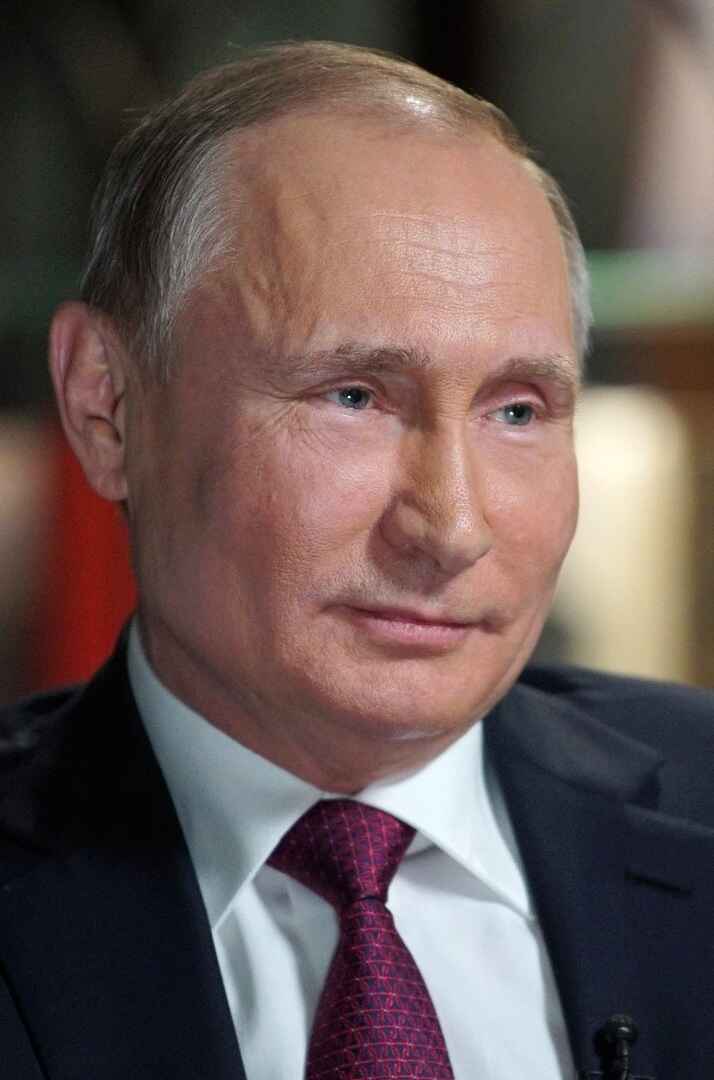
Top of the page: photograph of Vladimir Putin in 2018. Президент России Владимир Путин во время интервью журналисту американского телеканала NBC Мегин Келли. Photo copyright: www.kremlin.ru (via Wikipedia/Wikimedia Commons).
Article added on December 19, 2025 at 16:33 German time.


