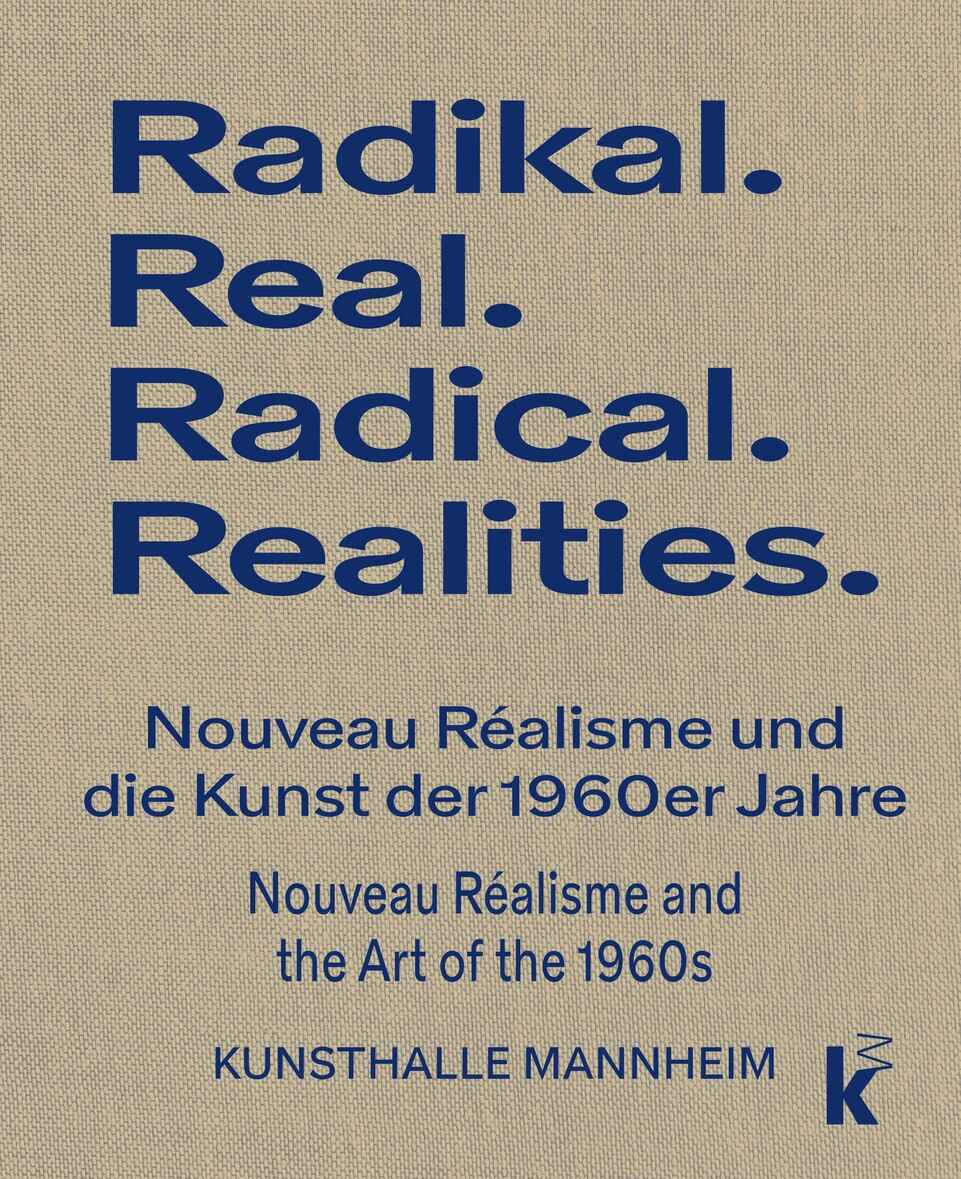
Already since July 3 and only until October 11, 2026 Kunsthalle Mannheim in Germany shows the exhibition Radical. Realities. Nouveau Réalisme and the Art of the 1960s. The show presents roughly 150 works by artists such as César, Christo, Yves Klein, Daniel Spoerri, Jean Tinguely and Niki de Saint Phalle, to name just a few.
At Yves Klein’s apartment at 14 Rue Campagne-Première in Paris, on October 27, 1960 a group of artists around the art critic Pierre Restany, who created the idea and coined the term “Nouveau Réalisme”, signed the Déclaration constitutive du Nouveau Réalisme. Artists in Europe, the USA and South America made reality itself the central object of art.
In her catalog contribution, Luisa Heese writes that, in 1959, the French artist César gave up painting and turned to his legendary Accumulations. According to her, with the work Fétiche à clous (Nail Festish), he created a symbol for a new direction in art. It heralded a fundamental shift in artistic practice. After years in which abstract and gestural expressive forms dominated, alternative approaches to reality now unfold.
Luisa Heese explains that artists turn to objects of consumer society, media images, urban spaces and the material traces of life. They experiment with new materials, actions, performative processes and simultaneously question the traditional role of artist, artwork and exhibition. Reality itself becomes the material of their art.
Nouveau Réalisme is marked by heterogeneity. It does not develop in one single place or in a unified style. Instead, comparable questions and artistic approaches emerge simultaneously in different cultural and political contexts in cities such as Paris, London, Milan, Stockholm, Dusseldorf, New York, Buenos Aires or Tokyo. The emerging artists focus the everyday world. They are united by the attempt to directly inscribe reality—and with it the conditions of the present of their time—into art.
According to Luisa Heese, the exhibition Radical. Realities. Nouveau Réalisme and the Art of the 1960s understands Nouveau Réalisme as a central point of departure in order to make these international constellations visible. It is not primarily about the history of a clearly delineated artists’ group. Instead, the focus of the project is on the networks, overlaps and connections which provide an understanding of Nouveau Réalisme less as a closed movement than as a nodal point within a widely branching cartography of the new realisms.
Luisa Heese points out to the historical background. Following the destruction of World War II, Europe experienced an unprecedented economic upswing. The Marshall Plan, reconstruction and industrialization promote the emergence of new consumer societies. At the same time, the traumas of war, occupation and annihilation continue. Decolonization, the Cold War, the nuclear arms race, the Algerian War in France and the construction of the Berlin Wall in Germany shape collective consciousness, while technological and scientific innovations change everyday life. The new perception of reality develops between belief in progress and an awareness of potential catastrophe.
At Yves Klein’s apartment in 1960 the artists present were Arman, François Dufrêne, Raymond Hains, Yves Klein, Martial Raysse, Daniel Spoerri, Jean Tinguely and Jacques Villeglé. The manifesto they signed contained a programmatic sentence about “new approaches to the perception of reality”. Luisa Heese stresses that the participating artists were connected less by a congruent style than a common attitude. Shortly after the signing the first conflicts and differences emerged; inner contradictions were a part of the project from the very beginning. It was precisely this heterogeneity that characterized Nouveau Réalisme as a key phenomenon of the neo-avant-garde.
Luisa Heese underlines that the Nouveaux Réalistes differenciated themselves from Art Informel and its gestural abstraction. Instead of creating works shaped by gesture, they employed industrial pigments, new materials such as plastic, torn posters, household waste, fragments of machines or found objects from the urban space. Reality was no longer to be “represented”, but directly integrated into art by means of material witnesses, everyday objects provided by the consumer society.
At the same time, the Mannheim exhibition takes a critical look at the connections and contrasts between Nouveau Réalisme and Pop Art. Luisa Heese mentions that, in London in the early 1950s, the Independent Group around Eduardo Paolozzi and Richard Hamilton formulate an engagement with the common goods of consumer society. In New York, galleries such as those of Leo Castelli or Sidney Janis establish new presentation forms soon to be known as Pop Art, represented notably by Andy Warhol. In Copenhagen legendary projects are hosted in the gallery of Arthur “Addi” Køpcke.
According to Luisa Heese, the Mannheim exhibition follows these connections, without reducing the history to a linear development to Pop Art. Instead, the show focuses on those positions that formulated quieter, more complex answers to the reality of their time. Special attention is paid to women artists whose important contribution to questioning of the real has been marginalized for a long time.
Drawing on significant works from the Kunsthalle Mannheim’s own collection, the exhibition traces the development of consumer society from the 1950s through the early 1970s, while also exploring the relevance of these artistic positions today. In addition, in dialogue with the Nouveaux Réalistes, the exhibition presents works by Jasper Johns, Alina Szapocznikow, Tetsumi Kudo, Chryssa and Feliza Bursztyn. Their output demonstrates just how international and multifaceted the search for new artistic languages was during this period.
As mentioned above, this is the last chance to visit the Mannheim exhibition, which closes its doors on Sunday, October 11, 2026. Obviously, the catalog remains available beyond this date.
The bilingual exhibition catalog, English and German, edited by Luisa Heese, with contributions by Luisa Heese, Stefano Agresti, Axel Heil, Déborah Laks: Radikal. Real. Radical. Realities. Nouveau Réalisme und die Kunst der 1960er Jahre. Nouveau Réalisme and the Art of the 1960s. Kunsthalle Mannheim, Wienand Verlag, 2026, 360 pages with 184 color and 51 black and whites illustrations, 22 cm x 27 cm. ISBN 978-3-86832-862-2. Accept cookies — we receive a commission; price unchanged — and order the bilingual English/German catalog from Amazon.co.uk, Amazon.fr, Amazon.de.
For a better reading, quotations and partial quotations in this catalogue and exhibition review are not put between quotation marks.
Article added on October 5, 2026 at 20:43 German time. Typos corrected and a detail added at 21:27.


