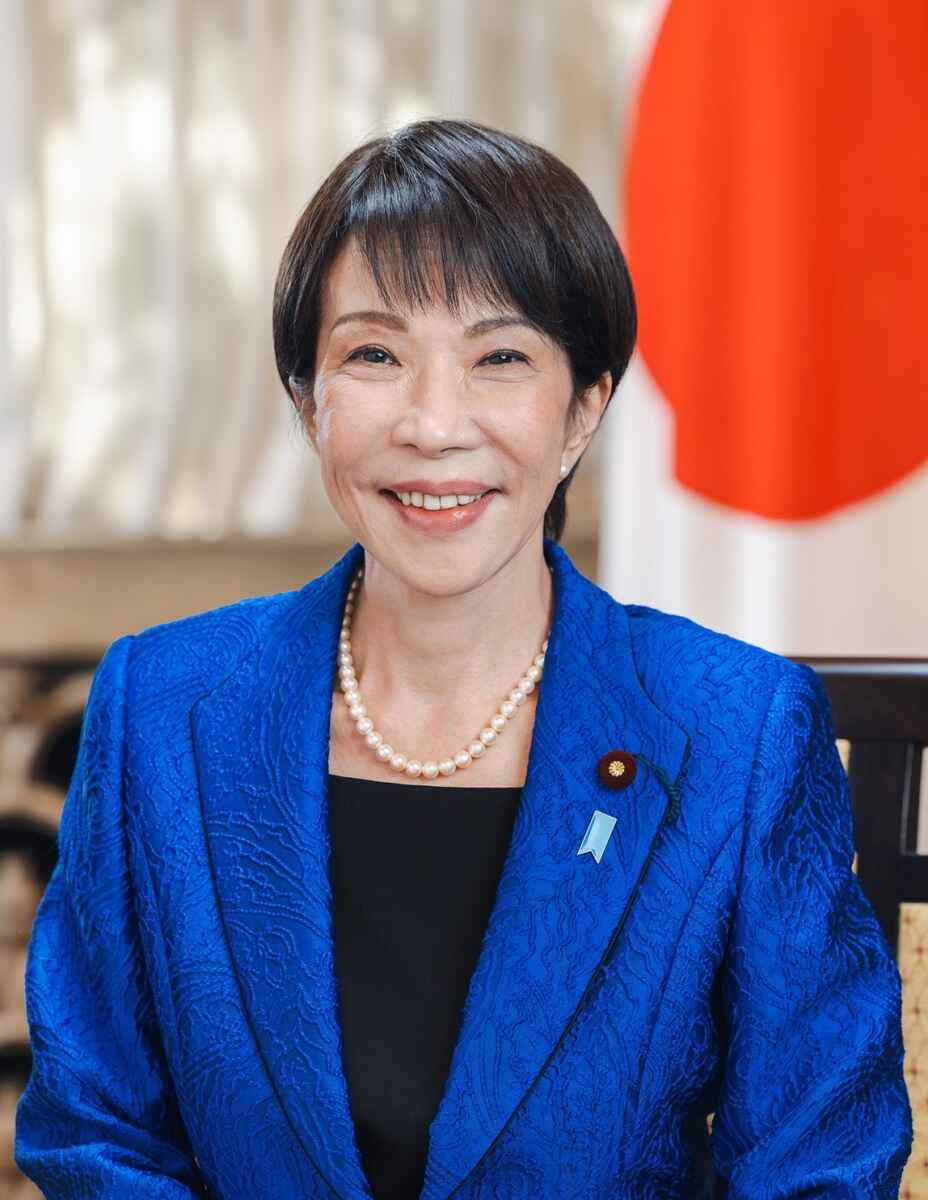
Last year, the peace promoting Komeito, a party affiliated with the Soka Gakkai religious movement, ended its long-time coalition with Japan’s Liberal Democratic Party (LDP). It had lasted from December 26, 2012 until October 12, 2025; already from 1999 until 2009, the two parties had formed a coalition government.
The Buddhist, pacifist Komeito was surely uneasy with the nationalist LDP pushing for higher defense spending in Japan, given the military agenda of China’s President Xi Jinping. Officially, the reason given by Komeito for the end of the coalition with the LDP was a disagreement over the illegal political financing practices by a number of LDP parliamentarians (slush fund scandal).
Before the end of the coalition, the LDP had held party leadership elections. On October 4, 2025 after the first round, the nationalist Sanae Takaichi (*1961) emerged as the frontrunner with 31.1% of the vote. She won the runoff vote against Shinjirō Koizumi (*1981), the son of the former prime minister Junichiro Koizumi (2001-2006) with 54.25% vs. 45.75%. The choice of the conservative and nationalist Sanae Takaichi triggered the Komeito chief representative Tetsuo Saito and the Komeito secretary general Makoto Nishida to withdraw from the coalition government because, according to them, she was unwilling to adequately address the LDP’s slush fund scandal, to clean up Japanese politics. It turned out to be political suicide.
Sanae Takaichi subsequently became the first female prime minister of Japan on October 21, 2025 after she had managed to form a coalition with the Japan Innovation Party (JIP; Nippon Ishin no Kai), a center-right to far-right populist party (according to whom you ask), founded in 2015. The party has its roots in a regional party from Osaka. It focuses on regionalism and reform. In the 2022 Japanese Councillors election, the JIP demanded, among roughly 400 things (!), to make Osaka Prefecture a “secondary capital”, to cut the number of diet members by 30%, and to cut the salaries of diet aka parliament members by 30%, to introduce a universal basic monthly income of ¥60,000.
Back to Sanae Takaichi who, as prime minister, has pushed through (another) government spending program – a recipe that has not worked since the 1990s and has led the Japanese public debt to exceed 230% of GDP! She wants to increase military spending, invest in artificial intelligence as well as in semiconductor manufactoring, while simultaneously proposing tax cuts.
Sanae Takaichi was a protégé of the late prime minister Shinzo Abe (2006-2007 and 2012-2020). His Abenomics – monetary easing, fiscal stimuli and structural reforms – delivered mixed results.
Shinzo Abe was a nationalist who had denied the Japanese Nanjing Massacre and Rape between 1937 and 1945. As for Sanae Takaichi, she opposed the inclusion of the number of Chinese casualties in Japanese school textbooks. In addition, she is a regular visitor to the controversial Yasukuni Shrine, which honors, among others, notorious Class A World War II war criminals from Japan.
In November 2025, the new and first female prime minister stood up against China and said that Japan would defend Taiwan, if attacked by China, because a chinese blockade or invasion of Taiwan would constitute a “survival-threatening situation”. This led to a retalation by the corrupt, pseudo-Communist regime in China, which limited the export of so-called rare earths – which are neither rare nor earths – and other strategically important minerals to Japan, stopped imports of Japanese seafood and limited Chinese (group) tourism to Japan.
A November 2025 poll by Japan’s largest newspaper Yomiuri Shimbun showed that 64% of younger voters between the age of 18 and 39 approved the hard-line by Sanae Takaichi and her government toward China. The overall approval across all ages for the hawkish position was 56%.
Prime Minister Sanae Takaichi’s personal approval ratings were consistently above 60%, which encouraged her – together with the positive polls for her government – to seize the moment and call a snap election for February 8, 2026. It paid off.
Today, voters gave the LDP a comfortable, absolute majority in the 2026 Japanese Lower House election. With 99.6% of the votes counted – turnout 55,7% (+1.84pp) –, the Liberal Democratic Party will win some 316 seats in the 465-seat House of Representatives. For an absolute majority, 233 seats would be enough. [Added at 20:06 The LDP wins a two-third majority!].
Sanae Takaichi represents the hard right in Japan. According to the White House press secretary Karoline Leavitt, Japan’s prime minister was among those who nominated President Trump for the 2025 Nobel Peace Prize, which the Venezuelian opposition leader Maria Corina Machada won and, on January 15, 2026 in a symbolic gesture, offered to President Trump, who had captured the Venezuelian dictator Maduro, but without changing the regime.
Japan has a shrinking population. Therefore, the country needs immigrants. At the same time, an important part of the Japanese population is not keen on additional foreigners. During her electoral campaign, Sanae Takaichi promised to be more restrictive on immigration, to fight illegal immigration. At the same time, the demographic decline needs a welcome culture.
Accept cookies — we receive a commission; price unchanged — and order beauty items from Amazon.com and Amazon.co.uk.
Official portrait of Japan’s Prime Minister Sanae Takaichi. Photo copyright: Ministry of Foreign Affairs of Japan. Photograph via Wikipedia/Wikimedia.
Article added on Febuary 8, 2026 at 19:56 German time. Added at 20:07 The LDP wins a two-third majority.


.jpg)