The Dresden Residenzschloss (castle or Royal Palace) hosts many treasures, including the world famous jewelry collection of the Green Vault (German article about Grünes Gewölbe), the Electoral Wardrobe at the Dresden Armory, the Kupferstich-Kabinett with its collection of prints, drawings and photographs.
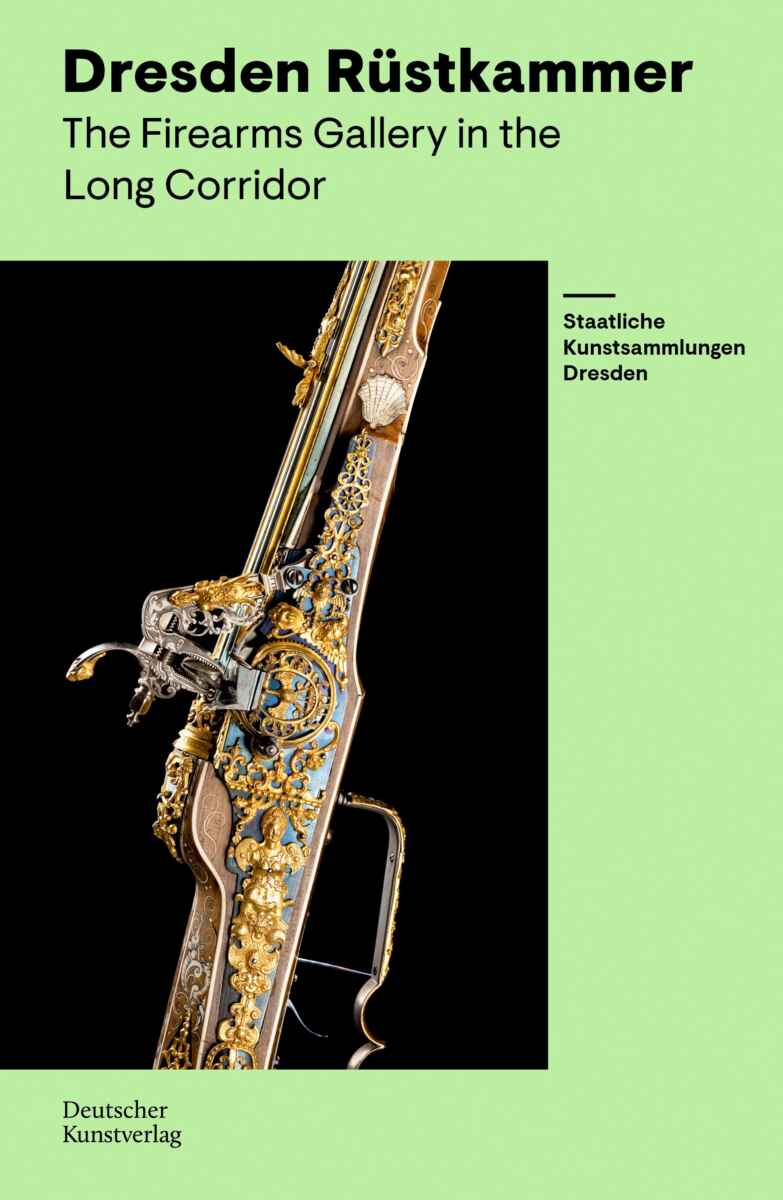
A new museum guide book sheds light on the Firearms Gallery in the Long Corridor (Gewehrgalerie im Langen Gang) in the Dresden Armory aka Rüstkammer. This guide is the work of Stefano Rinaldi, curator of the Dresden Armory, responsible for European edged weapons and firearms, and Gernot Klatte, scientific assistant at the Dresden Armory: Dresden Rüstkammer: The Firearms Gallery in the Long Corridor. Deutscher Kunstverlag, November 2025, 144 pages with 120 color illustrations, 15 × 23 cm 120. ISBN: 978-3-422-80313-8. Accept cookies — we receive a commission; price unchanged — and order the English edition of this book from Amazon.com, Amazon.co.uk, Amazon.fr, Amazon.de.
According to Stefano Rinaldi and Gernot Klatte, when it was first built, between 1588 and 1590, the Long Corridor had had a different function: it connected the Georgenbau wing of the Residenzschloss with the New Stable Building and served as an ancestral gallery. The young and ambitious Elector Christian I used it to demonstrate his sense of tradition and his political will to shape the future. The New Stable Building, designed by Paul Buchner, is where the most precious of the Elector’s personal horses and the holdings of the Armory aka Rüstkammer were kept.
The design of the Long Corridor was inspired by Giovanni Maria Nosseni, who had come to Dresden from Florence in 1575 as a sculptor, architect, and festival director. Christian I’s innovative architectural concept was modelled on precedents from France and Italy: King François I of France had had the first comparable galleries built in the Palace of Fontainebleau. Their idea – of using long connecting rooms as presentation spaces for dynastic, allegorical, and topographical picture cycles – was immediately taken up in the Papal Palace in Rome, by the Medici in Florence, as well as in the Town Residence of the Bavarian dukes in Landshut, and in Cardinal Albrecht of Brandenburg’s New Building in Halle an der Saale.
Starting in 1709, the Elector of Saxony and King of Poland, August the Strong, began reorganizing his collections. He founded the Kupferstich-Kabinett and the Green Vault, had the Rüstkammer moved from the New Stable Building into the old War Chancellery, and designated the Zwinger, one of Germany’s most important Baroque buildings, designed by the architect Matthäus Daniel Pöppelmann, as a Palais Royal des Sciences.
From 1722 onwards, August the Strong decreed that the firearms, which had previously been stored in various locations, should be brought together. However, it was left to his son Friedrich August, later King August III of Poland, to set up a dedicated display of the personal arms of the Elector (the so-called Leibgewehr) in the Long Corridor in 1733, which he continued to expand over the course of his reign. The Firearms Gallery remained in place until the Second World War and was reestablished in 2021.
Today, the Rifle Gallery in the Long Corridor of Dresden’s Royal Palace presents around 500 unique handguns from the collections of the Saxon electors and kings. The rifles and pistols from the 16th to 19th centuries were used for hunting, target shooting and courtly representation.
The new museum guide presents the detailed history of the collection as well as the architecture and furnishings of the Long Corridor. With its ancestral gallery, the approximately 100-metre-long Renaissance building embodied the dynastic memorabilia of the ruling family and housed the elector’s “personal rifle” from 1733. A richly-illustrated selection of objects presents a journey through three centuries of European gunsmithing and decorative art; the exhibits are elucidated in their complex cultural and historical contexts.
The Firearms Gallery in the Long Corridor presents masterpieces of the gunsmith’s art from one of the leading collections of royal weaponry in Europe. This is a permanent exhibition at the Dresden Armory aka Rüstkammer, in the Dresden Royal Palace aka Residenzschloss, Dresden State Art Collections (Staatliche Kunstsammlungen Dresden).
As an example of the many weapons presented in the new museum guide book, here some information collected by Gernot Klatte regarding the Flintlock shotgun by Johann Stephan Seeber, Suhl, 1750 (143.5 cm, Ø 15 mm, 3175 grams, inventory number G 899). This luxurious gun, made by the gunstocker and engraver Johann Stephan Seeber in 1750, represents a high point in the rococo decoration of Suhl luxury weapons. Delicately carved décor on the walnut stock, especially in the area around the tang and the small, as well as the top-quality gilded chiselled iron deco-rations and copper-gilt incrustations on the barrel, which show putti, a classical warrior, and an antique bust, culminate in a royal crown decorated with twenty brilliant-cut diamonds. This appears above the gilded thumb plate bearing the Polish-Lithuanian and Electoral Saxon coats of arms. The butt cap of the shotgun has even more extravagantly rococo decoration in gold: surrounded by rocailles, festoons, and small putti stands the figure of a ruler in classical costume being crowned with the laurel wreath by Ares. It is presumably intended to represent King August III. In his later years, Johann Stephan Seeber worked as a court engraver in Dresden.
This and much more detailed information can be discovered in the richly illustrated museum guide book by Stefano Rinaldi, curator of the Dresden Armory, responsible for European edged weapons and firearms, and Gernot Klatte, scientific assistant at the Dresden Armory: Dresden Rüstkammer: The Firearms Gallery in the Long Corridor. Deutscher Kunstverlag, November 2025, 144 pages with 120 color illustrations, 15 × 23 cm 120. ISBN: 978-3-422-80313-8. Accept cookies — we receive a commission; price unchanged — and order the English edition of this book from Amazon.com, Amazon.co.uk, Amazon.fr, Amazon.de.
For a better reading, quotations and partial quotations in this book review of Dresden Rüstkammer: The Firearms Gallery in the Long Corridor are not put between quotation marks.
Book review of Dresden Rüstkammer: The Firearms Gallery in the Long Corridor added on January 3, 2026 at 14:56 German time.


