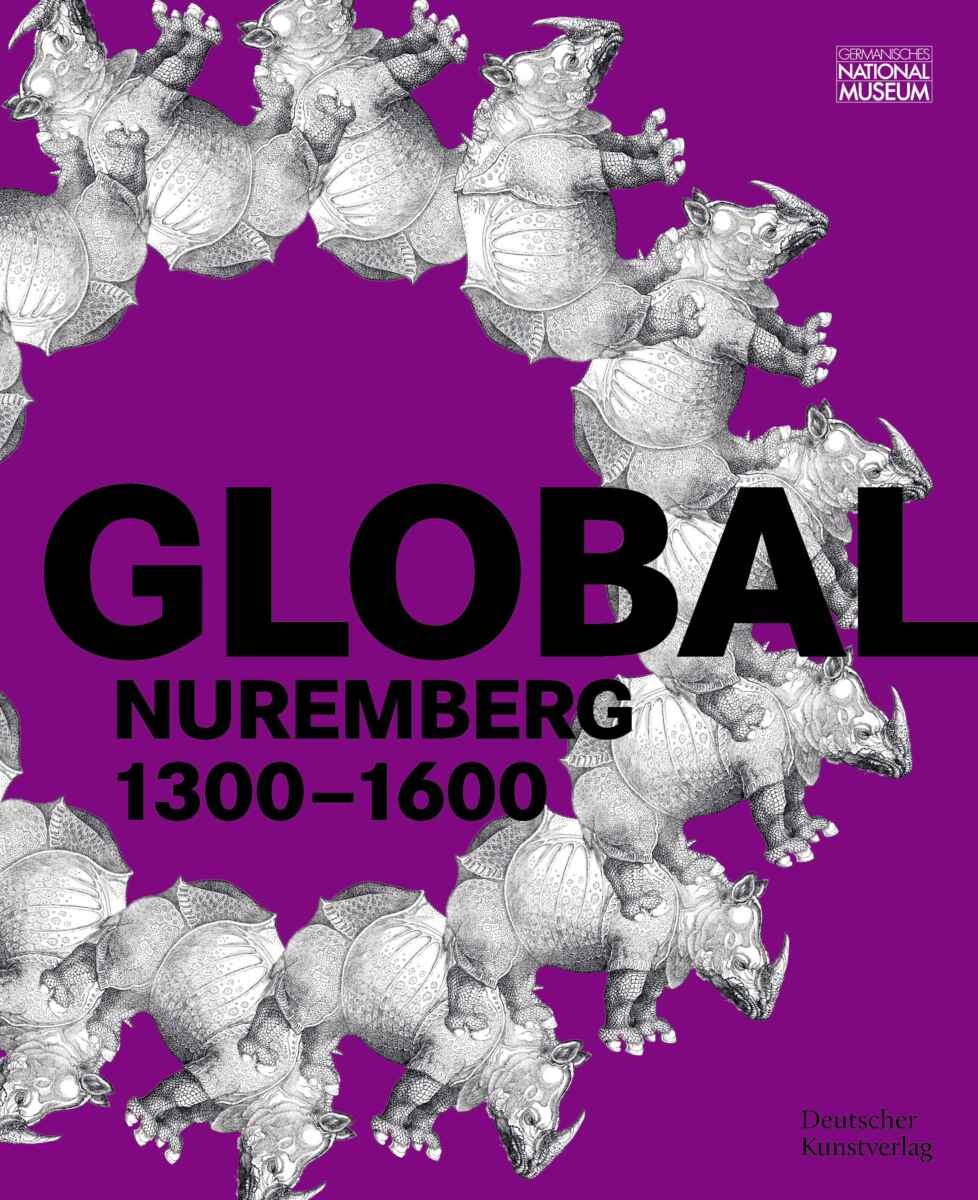
Already since September 25, 2025 and only until March 22, 2026 Germanisches Nationalmuseum in Nuremberg shows the exhibition GLOBAL Nuremberg 1300–1600. It explains how the city of Nuremberg (Nürnberg) developed into an international trading center in the heart of Europe between 1300 and 1600. Economy, politics, art, and culture were closely intertwined. The exhibition catalog traces the city’s expanding networks from the late Middle Ages to the Renaissance and critically reflects on Nuremberg’s role in an increasingly globalized world. The city’s success as an international hub of knowledge and an innovative industrial center enabled its cultural flourishing during the time of Albrecht Dürer. However, this prosperity was also built on the exploitation of resources, the booming arms trade, and early (dark) colonial activities, largely forgotten until today. This publication sheds light on these lesser-known aspects of Nuremberg’s history and presents fascinating objects from international collections.
Edited by: Germanisches Nationalmuseum, Benno Baumbauer, Sven Jakstat, Marie-Therese Feist: GLOBAL Nuremberg 1300–1600. English edition, Deutscher Kunstverlag, March 2026, 350 pages with 280 color illustrations, 22 × 27 cm, paperback. ISBN: 978-3-422-80341-1. Accept cookies — we receive a commission; price unchanged — and order the English edition of this exhibition catalogue from Amazon.com, Amazon.co.uk, Amazon.fr, Amazon.de.
In his catalogue Foreword, Daniel Hess, Generaldirektor at Germanisches Nationalmuseum in Nuremberg, explains that, at the moment of the creation of the famous, Nuremberg-made Behaim Globe (1492-1494), the oldest surviving three-dimensional model of the earth (excluding the Americas), Nuremberg was a global city, a hub in the worldwide exchange of knowledge. The Behaim Globe provides a specifically European view of the world around 1500—a world opened up for global trade after the voyages of Christopher Columbus.
Daniel Hess stresses that the Behaim Globe encapsulates the cultural-historical, technical, and economic knowledge of the period. And with its many errors, it stands as emblematic of the relativity of world knowledge. The world is no longer mapped out as a Christian pilgrimage from Paradise to the Flood, and from Bethlehem and Jerusalem to the Last Judgment, but instead as a global marketplace for newly available resources. According to Daniel Hess, in addition, this globe is a monument to humanity’s tendency to misuse broadened horizons for the purposes of power and exploitation.
The general director at Germanisches Nationalmuseum in Nuremberg writes that the history of world maps demonstrates the relativity of different perspectives: while the so-called Hereford Mappa Mundi of about 1300 focuses on Christian Jerusalem, the religious geography of Islam in the period locates the world’s center in Mecca. The Kangnido Map of 1402, a royal Korean commission, places the territorially superior China at the center and shows the Korean peninsula as the second-largest landmass.
Among the thirteen catalogue essays are articles about Nuremberg’s metals and the city’s networks in the European and global mining industry, the global luxury goods produced in Nuremberg, the fear and fascination between the Ottoman Empire and Nuremberg, Albrecht Dürer, Jewish mobility and urban integration in Nuremberg.
Meyrav Levy writes that the Jews of Nuremberg endured multifaceted anti-Judaism, including false accusations, massacres, and eventual expulsion in 1499 under King Maximilian I. They suffered from heavy taxation, remission of debts owed to them (Judenschuldentilgung, occurring in 1385 and 1390), and restrictions on their occupations and places of residence. At the same time, Medieval Nuremberg afforded Jews a certain degree of tolerance, largely owing to their economic contribution. The predominant Jewish occupation in the city was moneylending. Financial success elevated prominent Jewish figures who had ties to the centers of Christian power. Together with their families, wealthy Jews received citizenship. Meyrav Levy presents a story of integration and marginalization. Jews were thriving as a prominent community within European networks, while demonstrating resilience and adaptability amid adversity.
In his catalog essay, Daniel Hess stresses that the city of Nuremberg was in constant competition, primarily with Augsburg but soon also with “global players” such as Venice and Antwerp, Lisbon and Seville.
He also notes that at the end of the period examined here, in the 17th century, the Portuguese ceded their rule to the Dutch East India Company. With regard to Spain, he notes that the flow of silver from the mine of Potosí (in today’s Bolivia)—set in motion by German mining techniques and technical innovations—forever altered the global economy. It ended the silver shortage in China and halted the need for the inflationary paper money that had been introduced there as a substitute currency. This revolutionized trade within Asia. Spain, however, became hopelessly indebted and declared state bankruptcy in 1557.
Art traveled too. In 1521, Albrecht Dürer admired pieces of the Aztec treasure in Brussels. Daniel Hess assumes that some examples of Aztec art arrived in Nuremberg three years later: it was in Nuremberg, in 1524, that the latest curiosities shipped from the Americas are said to have been handed over to Archduke Ferdinand. That 1524 delivery apparently also contained the model for the famous map of Tenochtitlán, which was then printed as a woodcut in Nuremberg and distributed throughout Europe.
In their catalogue contribution, Benno Baumbauer and Sven Jakstat mention that Albrecht Dürer’s Rhinoceros woodcut is probably the most famous example of cultural exchange between India and central Europe in the early modern period. It became one of Dürer’s most commercially successful works, sought-after and circulated throughout Europe.
Rhinoceroses were surrounded by legend in the European imagination, informed mainly by the ancient author Pliny — that is, until Sultan Muzaffar Shah II of Cambay in India gifted a live specimen to Afonso de Albuquer que, the governor of Portuguese India in Goa. Albuquerque then had the two-ton animal and its Indian keeper shipped to Lisbon, where the rhinoceros joined the menagerie belonging to King Manuel I of Portugal. The mere existence of this animal served as living proof to Europeans that the tales told about the wonders of faraway India must be true. News of the rhino- ceros reached Dürer’s hometown of Nuremberg in a letter sent by Valentim Fernandes, a printer from Moravia who was active in Lisbon. The poor rhinoceros ultimately drowned off the coast of Liguria while being shipped to Rome as a gift to Pope Leo X. But the creature lived on in Dürer’s woodcut (more in German about Albrecht Dürer).
Early on, Nuremberg trading houses and merchants were active in India — they invested in the great Portuguese expedition to India of 1505-06, led by Francisco de Almeida. A mother-of-pearl basin crafted in Gujarat was shipped to Lisbon, then transported to Nuremberg, where it was set into a mount by the goldsmith Nicolaus Schmidt (d. 1609) and later sold to the princely court of Saxony; it is now kept in the Green Vault in Dresden (German article about das Grüne Gewölbe).
These are just a few details from the richly-illustrated exhibition catalogue, edited by Germanisches Nationalmuseum, Benno Baumbauer, Sven Jakstat, Marie-Therese Feist: GLOBAL Nuremberg 1300–1600. English edition, Deutscher Kunstverlag, March 2026, 350 pages with 280 color illustrations, 22 × 27 cm, paperback. ISBN: 978-3-422-80341-1. Accept cookies — we receive a commission; price unchanged — and order the English edition of this exhibition catalogue from Amazon.com, Amazon.co.uk, Amazon.fr, Amazon.de.
For a better reading, quotations and partial quotations in this catalogue and exhibition review of GLOBAL Nuremberg 1300–1600 are not put between quotation marks.
Catalog and exhibition review of GLOBAL Nuremberg 1300–1600 added on March 11, 2026 at 11:10 German time.


